eBay does not insure sellers against every chargeback. It offers payment dispute seller protections that apply only to specific dispute reasons and only when you can document the transaction, and the buyer's bank or payment provider, not eBay, makes the final decision. This guide explains what the protection covers, what it costs when it does not apply, which evidence matters, and how to avoid chargebacks in the first place.
What an eBay chargeback is, and how it differs from a return
A payment dispute occurs when a buyer asks their bank, credit card issuer or other payment institution for their money back directly. eBay describes this as distinct from the Money Back Guarantee, which is the process the buyer runs through eBay itself. The two channels have different decision makers: eBay decides Money Back Guarantee cases, while the payment institution decides disputes.
Buyers cannot use both routes to be refunded for the same transaction. In practice, a buyer who opens a dispute with a card issuer while an eBay case is open creates a conflict that you should flag in your evidence. A buyer who has already been refunded through eBay and then disputes the charge anyway is the clearest case for challenging.
This distinction matters because the protections you rely on differ. Money Back Guarantee outcomes follow eBay's own rules. Payment disputes follow the rules of the card network and the issuing bank, with eBay acting as the intermediary that collects your evidence.
What eBay's payment dispute seller protections cover
According to eBay's US policy, protections may apply when the buyer opens a dispute because they did not receive the item, because they do not recognize the transaction or have an issue with it, or because the item does not match the listing. Outside those reasons, you should assume no protection.
The policy also says eBay may apply protection automatically, without you doing anything. When it does, you are not charged the dispute fee and eBay does not seek reimbursement if the buyer ends up with a full refund. Protection can also follow an earlier resolution, for example when the dispute relates to a Money Back Guarantee case that eBay already closed in your favor or with a full refund to the buyer.
Three points are easy to miss:
- The goods must be physical. The eligible scenarios in the policy are written around physical items with evidence of delivery or pickup.
- Evidence of delivery is the center of the policy. For "not received" and "not recognized" disputes, eBay asks for carrier tracking showing successful delivery to the address the buyer gave at checkout, or proof of pickup.
- Protection is not a guarantee about the bank's ruling. The final outcome belongs to the payment institution, but where eBay determines the item was delivered or collected, it states it will waive or refund your dispute fee and will not seek reimbursement for the disputed amount.
For a broader look at where seller protection stops, see our breakdown of what eBay seller protection covers and what it does not.
What it costs when protection does not apply
In the United States, eBay charges a $20 dispute fee when a buyer starts a payment dispute, and sellers are not charged more than one dispute fee per order, even if the buyer used more than one form of payment. The fee can be waived or refunded when you qualify for protection or win the dispute.
The outcomes work as follows:
| Outcome | What happens to you |
|---|---|
| Decided in your favor | You are not charged a refund and you do not pay the dispute fee |
| Decided in the buyer's favor, protection applies | No reimbursement sought for the disputed amount, and the fee is waived or refunded |
| Decided in the buyer's favor, no protection | You may owe the refund amount and the dispute fee |
| You accept the dispute | The refund is generally taken from Available, Processing or On hold funds, and if those are not enough, from your payment method on file |
The funds mechanics come from eBay's help page on handling payment disputes, and the liability rule for buyer-favored decisions is reported in coverage of eBay's fee policy.
The arithmetic is worth running on your own catalog. Auction Nudge notes that on low-value items the $20 fee can exceed the sale price, so a lost dispute on a $12 part costs more than the part. For sellers of small, inexpensive items, a single lost dispute can erase the margin on many orders.
Deadlines and timing
EBay's US policy lists two actions, accepting the dispute or challenging it with evidence, and gives each a window of 5 calendar days after the notification is received. That is short, and a missed window can mean losing by default.
There is some mitigation: eBay may respond automatically on your behalf using its own transaction information if you do not respond in time. That automatic response is limited to data eBay already holds, so it will not contain your photos, packing records or message history. Do not treat it as a substitute for answering.
After you challenge, the wait is long. The final decision rests with the buyer's payment institution, and the process can take 90 days or more. Keep your records for at least that long, and plan cash flow on the assumption that funds tied to a disputed order may be held during that time.
Practical steps for the notification window:
- Turn on email and app notifications for payment disputes, and check the Payments tab in Seller Hub on a fixed schedule so a missed email does not cost you a case.
- Open the order and note the dispute reason, because the evidence you need depends on it.
- Decide within a day whether to accept or challenge, and do not wait for day five.
- Upload everything in one submission, since eBay's updated process allows multiple file uploads and a written explanation.
Evidence that holds up
The evidence should match the dispute reason. The policy is specific about what eBay looks for.
Item not received or transaction not recognized
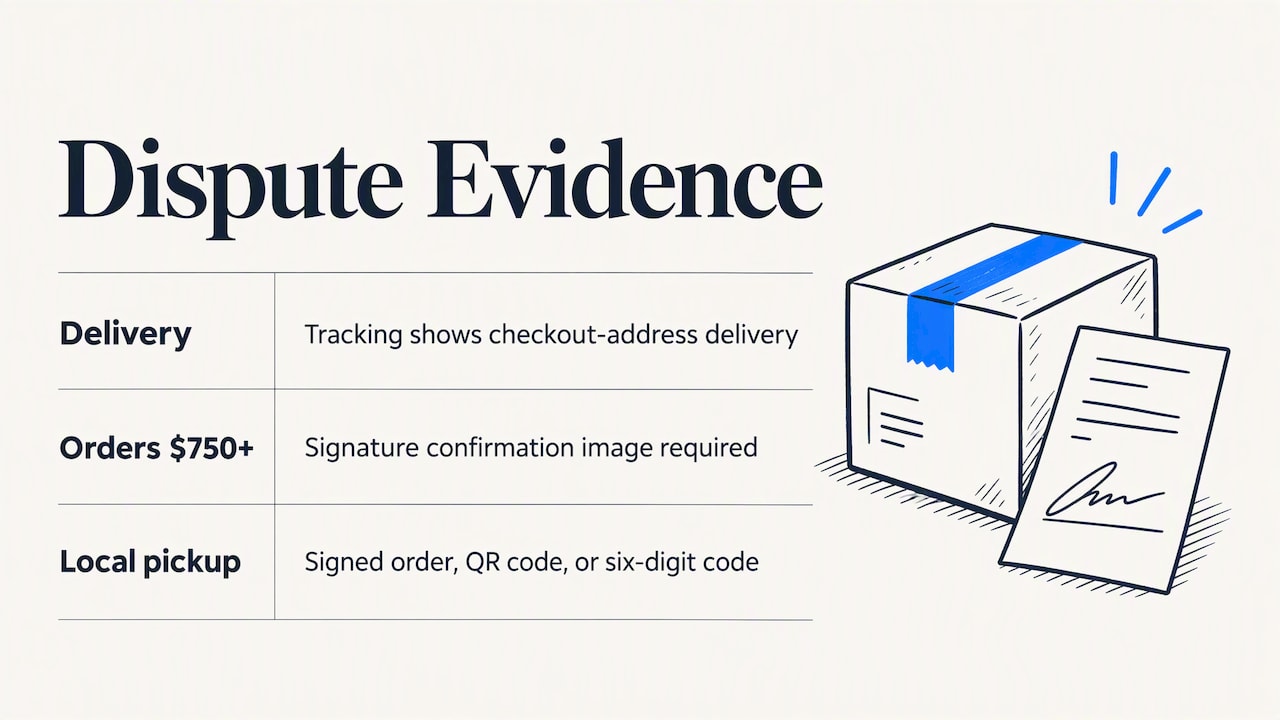
EBay asks for carrier tracking showing successful delivery to the checkout address, or proof the buyer collected the item. For orders totaling $750 or more, the policy also requires proof that you purchased signature confirmation, uploaded as an image. If you sell higher-priced goods, that single rule can decide the outcome, and it is cheap to build into your shipping routine.
For local pickup, the policy lists order ID, item number, title, amount paid, collection date, the buyer's signature and photo ID if available, and the pickup address. When the buyer collects directly from you, a signed copy of the order details or a scan of the buyer's QR code or six-digit pickup code in the eBay app counts as evidence.
Item not as described
When the buyer says the item does not match the listing, eBay asks for evidence such as photographs of the item's condition before shipment. Pre-shipment photos taken at packing, with the label visible where possible, are the most direct answer.
What to keep for every order
- The listing as published, including photos, the item specifics and any compatibility notes.
- Pre-shipment photos and, for serial-numbered goods, the serial number.
- The carrier receipt, tracking and delivery confirmation.
- All buyer messages sent through eBay, since conversations outside the platform are hard to use as proof.
- Any refund or return record, so you can show a prior resolution.
How to avoid chargebacks on eBay
The research behind this guide found no single authoritative source on prevention, so the recommendations below follow directly from the evidence rules above and from what we see in seller reports. Treat them as practices that make your evidence stronger, not as promises of outcome.
Make the listing hard to dispute
A large share of disputes begin with a buyer who feels the item was not what they expected. Write specifications you can verify, photograph defects, state condition in plain terms and, for parts, list model numbers and compatibility precisely. A listing that already documents the flaw is the strongest answer to a claim that the item did not match. Our free listing analyzer scores a listing for completeness, which is a quick way to find thin descriptions before they become disputes.
Ship in a way you can prove
- Always use tracked shipping with an eBay-purchased or otherwise verifiable label that shows delivery to the checkout address.
- Buy signature confirmation on orders of $750 or more, and consider it below that threshold for items that are frequently targeted.
- Do not ship to an address different from the one on the order, even on request, because evidence of delivery is tied to the checkout address.
- Photograph the sealed package with the label before handing it to the carrier.
Keep communication on the platform
Buyers who receive prompt, clear messages are less likely to go to their bank and more likely to ask you first. Send a confirmation when the order is placed, a shipping notice with tracking, and a follow-up after delivery. An automatic post-purchase message keeps that routine consistent when volume grows, and the messages themselves become part of your record. Handle returns and refunds through eBay rather than by side agreement, so the refund history is on file if the buyer later disputes the charge.
Respond to feedback and complaints early
A buyer who writes a negative review and gets no answer is more likely to escalate. Timely replies show good faith, and an AI feedback autoreply can help you respond to every comment without delay. If a buyer threatens a bad review unless you refund or compensate them, our guidance on feedback extortion explains why to preserve the evidence rather than pay.
Screen the buyer before you ship
Since 2008 eBay has not let sellers leave negative feedback for buyers, so a buyer who files false claims leaves no public trace on the platform. Repeat offenders therefore move from seller to seller. Checking a buyer's history before you ship is one of the few preventive steps available. You can check an eBay buyer's status and, when a buyer has defrauded you, report the buyer with evidence so that other sellers are warned. Our guide to eBay seller scams covers the time-sensitive steps to take when a fraud pattern appears, and our article on unpaid items covers a related case.
Our perspective
We built SafeBay around one gap that chargeback protection does not close. EBay's protection works transaction by transaction: it can waive a fee or decline to seek reimbursement for one order, but it does not stop the same buyer from disputing the next seller's order. Because sellers cannot leave negative feedback for buyers, the platform keeps no seller-facing record of that behavior.
That is why we think prevention and documentation should be treated as two separate jobs. Documentation, meaning tracking, photos, listing records and messages, determines whether you can win or be protected after a dispute. Prevention, meaning screening and blocking, determines how many disputes arrive at all. A seller who only documents will keep paying in time and risk. A seller who only blocks will still lose cases on honest-looking claims.
Our approach is a community blacklist. Sellers report problem buyers with evidence, the reports are reviewed, and approved entries sync to your eBay Blocked Buyers list through a free Chrome extension. Reports keep their reasons and dates, private and public blocks are separate, and appeals are supported, because a blacklist without accountability would simply be a new source of error. We do not claim that this stops every chargeback, and no tool should be read that way. It reduces repeat exposure to buyers other sellers have already documented, and the evidence habits above remain necessary.
— Mykola
Using SafeBay alongside your dispute process
The SafeBay Companion Chrome extension syncs reviewed buyer blocks to your eBay Blocked Buyers list and shows risk alerts while you work in eBay. The Free plan costs $0 per month and includes basic features with limited AI usage. Paid plans are Basic at $9.95 per month, Pro at $59.95 per month and Enterprise at $599.95 per month, for higher limits and advanced features. Starting on the free tier is enough to see whether buyer screening fits your workflow.
A short checklist before you ship
- Does the listing state condition, compatibility and defects in verifiable terms?
- Is the shipping method tracked, and is signature confirmation purchased where the order is $750 or more?
- Are pre-shipment photos saved with the order?
- Has the buyer been checked, and is the delivery address the one on the order?
- Are dispute notifications on, with a daily check on the 5-day window?
FAQ
Does eBay protect sellers from chargebacks?
Partly. EBay's payment dispute seller protections can apply to "not received," "transaction not recognized" and "not as described" disputes when the policy's evidence requirements are met. If protection applies, eBay does not seek reimbursement for the disputed amount and waives or refunds the dispute fee. It is not a blanket guarantee, and the payment institution still makes the final decision.
How long do I have to respond to a payment dispute?
EBay's US policy gives you 5 calendar days after the notification is received to accept or challenge the dispute. If you miss the window, eBay may respond using its own transaction information, which usually lacks your photos and messages. Check your Seller Hub notifications daily.
What is the eBay chargeback fee?
In the US, eBay charges $20 per disputed order, and not more than one fee per order. The fee is waived or refunded if you qualify for seller protection or the dispute is decided in your favor. On low-priced items the fee can be larger than the sale itself.
Can a buyer use both an eBay return and a chargeback?
Not for the same transaction. A buyer cannot use the Money Back Guarantee and a payment dispute to be refunded twice. If a buyer opens a dispute after eBay has already resolved the case or refunded them, include that history in your evidence.