Every day, thousands of eBay sellers face a devastating reality: the very protections designed to facilitate fair commerce are being exploited against them. If you're scaling your eBay business, you're not just growing revenue—you're exponentially increasing your exposure to sophisticated return fraud schemes that can wipe out months of profit in a single chargeback.
The $2.3 billion problem plaguing online marketplaces isn't going away, and eBay sellers are bearing the brunt of it. Understanding eBay seller protection gaps and implementing proactive defense mechanisms isn't optional anymore—it's essential for survival.
Key Takeaways
- Return fraud costs eBay sellers an estimated $1.8 billion annually, with individual sellers losing between $3,000-$15,000 per year on average
- Traditional eBay seller protection leaves critical gaps, especially for return fraud scenarios involving empty boxes, switched items, and false "item not as described" claims
- Implementing an eBay buyer blacklist and preventive screening can reduce fraud incidents by up to 73% before transactions occur
- Advanced eBay seller tools like SafeBay provide real-time fraud detection and shared intelligence networks that standard seller protections cannot offer
- Sellers who implement comprehensive eBay return fraud prevention strategies report 4-6x ROI within the first quarter of adoption
The Hidden Crisis Destroying eBay Businesses
While you're focused on sourcing inventory, optimizing listings, and managing logistics, fraudsters are studying your vulnerabilities. The modern return fraud landscape has evolved far beyond simple buyer's remorse—it's become a sophisticated operation that targets high-volume sellers specifically because they have the most to lose and the least time to fight individual cases.
Real Numbers from Real Sellers
Consider these scenarios from actual eBay sellers in 2023:
- A electronics reseller in California lost $12,400 in a single month when four separate buyers claimed laptops arrived damaged, returned empty boxes weighted with books, and eBay sided with the buyers on all cases
- A fashion seller with 98.7% positive feedback lost her account standing after a coordinated attack by three buyers who purchased high-end handbags, filed false claims, and kept the merchandise while receiving full refunds—total loss: $8,900
- An automotive parts seller documented 23 instances over six months where buyers swapped defective parts for his new inventory, claiming "item not as described"—cumulative loss: $19,300
These aren't isolated incidents. They represent a pattern that's accelerating as fraudsters share tactics in closed forums and coordinate attacks against sellers who appear vulnerable. Without adequate eBay seller protection measures, your business becomes an easy target.
How Return Fraud Actually Works (And Why Standard Protection Fails)
Understanding the mechanics of return fraud is your first line of defense. Fraudsters exploit the inherent asymmetry in eBay's buyer-focused policies, knowing that the platform typically sides with buyers to maintain marketplace trust.
The Empty Box Scheme
This is the most common and devastating form of return fraud. Here's the typical pattern: A buyer purchases a high-value item (electronics, jewelry, designer goods), receives it, and files a return claiming "item not as described" or "damaged in transit." They then return an empty box, a box filled with worthless weight to match shipping expectations, or occasionally the original product box containing a broken similar item.
Standard eBay seller protection often fails here because proving the box was empty requires video documentation of the return package opening—evidence most sellers don't capture until they've already been victimized multiple times.
The Switch and Return
More sophisticated than the empty box, this scheme involves buyers who actually need the product category but want it for free. They order your new, authenticated, or high-grade item, swap it with their broken or counterfeit version, then return the inferior product claiming it "doesn't work" or "isn't what was advertised."
One power seller of refurbished electronics shared that he lost approximately $23,000 over eighteen months to this exact scheme before implementing serial number documentation and pre-shipment photography protocols—defensive measures that should have been unnecessary but became essential survival tactics.
The False Claim Epidemic
Sometimes fraudsters don't even bother with the return. They simply file an "item not received" claim or chargeback with their credit card company while keeping your merchandise. By the time you respond with tracking information showing delivery, the buyer has often already received a provisional credit, and eBay's dispute resolution timeline works against sellers who can't dedicate hours to each case.
Why Traditional eBay Seller Protection Isn't Enough
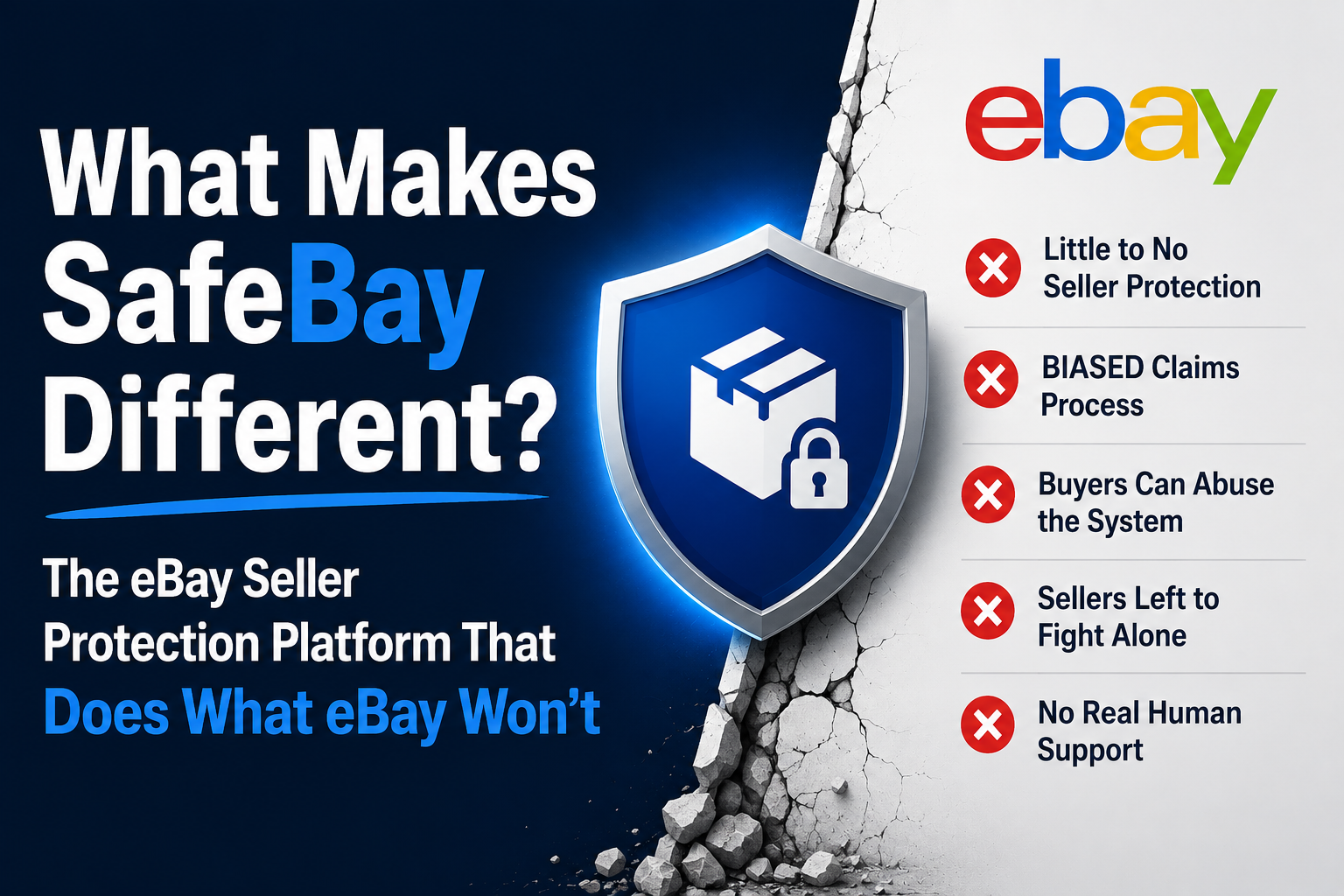
eBay does offer seller protection programs, but they're designed for the platform's interests—not necessarily yours. The standard protections cover obvious fraud cases but leave massive gaps in the scenarios that actually bankrupt sellers.
The Coverage Gaps That Cost You Money
eBay's seller protection typically covers you when a buyer claims they didn't receive an item and you have tracking showing delivery. That's helpful, but it doesn't address:
- Returns containing different or damaged items than what you shipped
- Buyers who file chargebacks after receiving refunds through eBay
- Systematic targeting by repeat fraudsters who create new accounts
- "Item not as described" claims where burden of proof falls entirely on you
- Partial refund demands that are actually extortion ("refund $100 or I'll leave negative feedback")
According to seller surveys, approximately 67% of fraud-related losses occur in categories where eBay seller protection either doesn't apply or requires extensive documentation that wasn't captured before the transaction.
The Reactive vs. Proactive Problem
The fundamental flaw in relying solely on eBay's built-in protections is that they're entirely reactive. You can only invoke protection after you've already been victimized, your inventory is gone, and you're fighting to recover losses. This approach doesn't prevent the fraud, doesn't save you the time spent on disputes, and doesn't protect your seller metrics from the negative impact of cases and returns.
What scaling sellers actually need is proactive eBay return fraud prevention—the ability to identify high-risk buyers before accepting their orders, to block known fraudsters automatically, and to document transactions with the specific evidence needed when disputes inevitably occur.
The SafeBay Approach to eBay Return Fraud Prevention
This is where specialized eBay seller tools have emerged to fill the protection gap. SafeBay and similar platforms operate on a fundamentally different principle: prevention through intelligence.
How an eBay Buyer Blacklist Actually Works
The cornerstone of effective fraud prevention is knowing who you're dealing with before the transaction occurs. An eBay buyer blacklist isn't about discrimination—it's about pattern recognition and shared intelligence.
SafeBay maintains a continuously updated database of buyers who have engaged in confirmed fraudulent activity across its network of protected sellers. When a buyer with a history of empty box returns, chargeback abuse, or serial "item not as described" claims attempts to purchase from you, you receive an instant alert with the specific risk factors associated with that account.
You then have options: block the purchase entirely, require signature confirmation, document the transaction more thoroughly, or proceed with eyes open to the elevated risk. This decision-making capability before the transaction occurs is something traditional eBay seller protection simply cannot provide.
Real-Time Risk Scoring and Pattern Detection
Beyond simple blacklists, sophisticated eBay seller tools analyze buyer behavior patterns that indicate fraud risk:
- New accounts making high-value purchases
- Buyers requesting shipping address changes after purchase
- Accounts with unusual purchasing patterns (buying multiple identical items, purchasing far outside their typical categories)
- Buyers with histories of excessive returns even without confirmed fraud
- Geographic correlation with known fraud hotspots
A SafeBay review by a jewelry seller in New York documented how the platform's risk scoring identified eight high-risk transactions in her first month of use. She blocked six of those sales and required additional documentation for two others. Based on the patterns detected, she estimates the preventive action saved her approximately $11,000 in potential fraud losses—far exceeding the cost of the protection service.
Implementing Comprehensive Protection for Your eBay Business
Protecting your eBay business requires a multi-layered approach that combines platform policies, documentation protocols, and specialized tools.
Immediate Actions Every Seller Should Take
Even before implementing advanced eBay seller tools, you can reduce your vulnerability:
- Document everything: Photograph items with serial numbers visible, weigh packages and photograph shipping labels, consider video documentation for high-value items
- Use signature confirmation: For any item over $250, the $3-4 cost for signature confirmation is cheap insurance
- Review buyer profiles: Check feedback, account age, and purchase history before shipping high-value items
- Respond quickly to messages: Many fraud attempts can be identified by unusual questions or requests in buyer communications
- Set clear return policies: While eBay mandates returns, your policy language can establish expectations and documentation requirements
When to Upgrade to Professional eBay Seller Protection
If your eBay business meets any of these criteria, professional protection tools become essential rather than optional:
- Monthly sales exceeding $10,000 (exposure justifies protection cost)
- Average transaction value above $100 (fraud attempts target higher-value items)
- Selling in high-risk categories: electronics, designer goods, jewelry, collectibles
- Experiencing more than 2-3 suspicious returns per month
- You've already lost $1,000+ to confirmed fraud in the past year
The ROI calculation is straightforward: if a platform like SafeBay costs $50-100 monthly but prevents even one $2,000 fraud incident per quarter, you're ahead $7,600 annually while also saving countless hours of dispute management time.
The Cost of Inaction vs. Proactive Protection
The real question isn't whether you can afford eBay seller protection tools—it's whether you can afford to operate without them while scaling your business.
Consider the full cost of a single return fraud incident: the lost merchandise (100% inventory cost), the refund amount (100% of sale price), the shipping costs (both directions), the platform fees you don't recover, the time spent on disputes (easily 3-5 hours at $50-100/hour effective rate), and the impact on your seller metrics that affects future visibility.
A single $1,000 fraud incident actually costs you approximately $1,400-1,600 when all factors are included. If you're experiencing just one incident monthly—which is conservative for sellers doing $50,000+ in monthly volume—that's $16,800-19,200 in annual losses.
Comprehensive eBay return fraud prevention through specialized platforms typically costs $600-1,200 annually while reducing fraud incidents by 60-80%. The math is compelling: spend $1,000 to save $12,000-15,000 while reclaiming dozens of hours previously spent fighting chargebacks and disputes.
Protecting Your Business Starts Today
The eBay sellers who thrive long-term aren't necessarily those with the best products or the lowest prices—they're the ones who protect their operations from the systematic threats that bankrupt competitors. Return fraud isn't going away; in fact, as economic pressures increase and tactics spread through fraud communities, the problem is accelerating.
You've built your eBay business through smart sourcing, excellent customer service, and operational efficiency. Don't let preventable fraud undermine everything you've created. Whether you're currently losing money to return fraud or simply want to prevent it before it starts, the protective measures you implement today will determine whether you're still profitably scaling next year.
SafeBay was specifically designed to address these critical protection gaps with an eBay buyer blacklist, real-time risk assessment, and the shared intelligence network that turns every protected seller into part of a collective defense system. The platform integrates directly with your eBay workflow, requires minimal setup time, and starts protecting your business from the first transaction. When your margins depend on preventing fraud rather than fighting it after the fact, specialized eBay seller tools aren't an expense—they're one of your highest-ROI investments.
Visit SafeBay today to protect your eBay business before the next fraudulent return costs you thousands.