For most US sellers, a flat restocking fee on a change-of-mind return is no longer a practical option on eBay. eBay.com removed restocking fees from the return-policy choices in 2018, and its current guidance steers sellers away from them. What remains is narrower: a seller who offers free returns may, in defined situations, deduct part of the refund when an item comes back used, altered or damaged. This guide explains the difference, the limits, the documentation that protects you, and how to cut down on the returns that trigger these disputes in the first place.
Are restocking fees allowed on eBay?
The short answer is that the old, simple restocking fee is gone, while a few narrow exceptions and a separate deduction mechanism remain. The confusion comes from the fact that eBay's own pages and seller forums describe the topic differently depending on the date, the program and the account type.
The timeline is straightforward. A trade report on eBay's 2018 Spring Seller Update states that eBay.com removed restocking fees as a return-policy option beginning in May 2018, leaving five return options. Since then, a seller cannot simply tick a box that says "buyer pays a 20% restocking fee."
eBay's Seller Center is more nuanced. Its returns best practices page says sellers have the option to charge a restocking fee, recommends a reasonable amount and asks that it be disclosed clearly in the return-policy details. The same page explains why it does not push the practice: fees can discourage purchases and lead to lower feedback. Meanwhile, the Top Rated returns guidance says charging a restocking fee is not a best practice and states that a seller can charge up to 15% of the item price for items requiring substantial handling.
How should a seller read these together?
- Do not build your business model around a restocking fee. Treat it as an exception for items that genuinely require substantial handling, not as a deterrent to remorse returns.
- Never assume a fee is available on your listing. Open your business policy settings and see what your account actually offers. If the option is not there, you cannot charge it.
- Do not argue with a buyer on the basis of forum posts. Sellers on community boards often disagree, and some answers are years old. The Seller Center and the help pages are the reference.
Restocking fee versus refund deduction
These two ideas are often mixed up, and mixing them is the most common way sellers get into trouble.
A restocking fee is a charge for the work of putting an item back in inventory. It applies regardless of condition and is, in effect, a penalty for returning.
A refund deduction recovers value that was actually lost. eBay's help page on handling a return request states that sellers may deduct from a refund only when an item is returned used, altered or damaged, that the maximum deduction is 50%, and that it should recoup actual loss, not cover shipping or restocking costs.
The practical consequences:
| Situation | Restocking fee logic | Refund deduction logic |
|---|---|---|
| Buyer changes mind, item sealed and unused | Not a sound basis for a charge | No deduction: issue the full refund |
| Item returned with visible wear or missing parts | Not the right label | Possible deduction to the extent value was lost |
| Item returned damaged by the buyer | Not the right label | Possible deduction, up to the cap |
| Item arrives not as described | Never appropriate | Never appropriate: seller bears the cost |
The help page also notes that a deduction applies when the item's condition has changed from how it was originally sent. That phrase matters: the benchmark is the condition you shipped, which is why your own photos and packing records carry weight.
Who can use deductions
eBay's seller protections page says sellers who are not Below Standard and who offer free returns may be eligible to deduct up to 50% for lost value when an item is returned used or damaged. The page I read is eBay's UK version, and eligibility rules differ by marketplace, so confirm the US wording in your own Seller Hub before you apply it.
Sellers should also know that the protection can be lost. According to eBay's seller protections abuse policy, sellers who misuse protections may lose eligibility, and eBay may remove listings, issue warnings, restrict activity or suspend accounts. Using a deduction as a disguised restocking fee is exactly the kind of behavior that policy is aimed at.
How to process a return step by step
A consistent process protects you in both directions: it keeps honest buyers satisfied and builds a record if a case escalates.
- Approve the return within your policy. Respond promptly and keep communication inside eBay messages.
- Wait for the item and inspect it. eBay's Seller Center advises waiting for the return, inspecting it and refunding within two days of receipt. If the buyer does not comply with the return policy, you can ask eBay to step in.
- Photograph the package and item on arrival. Capture the outer box, the label, the item, serial numbers and any damage. Compare them with your original listing photos.
- Decide: full refund or deduction. If the item is in the same condition you sent, refund in full. If it is used or damaged, calculate the lost value honestly.
- Use the Returns dashboard. If you are eligible, select Report Problem or Refund Now, enter the reason for the deduction and add a comment explaining why the refund is not full. The help page says to issue the refund within 2 business days of receiving the item.
- Explain in plain terms. A short, factual note works better than an accusation.
The explanation can be as simple as this: "The returned unit shows scratches on the front panel and a missing mounting bracket that were not present when shipped. Photos are attached. We have refunded the purchase price minus a deduction for the missing part."
If the buyer asks eBay to step in after a qualifying deduction, eBay's seller protections page says it will keep the return open for up to 10 days to help resolve the buyer's concerns, and that this will not count as a case closed without seller resolution. Your documentation from step 3 is what carries you through that window.
Who pays return shipping
Shipping is the other half of the cost conversation, and it is separate from any fee. For items that are not as described, eBay's Seller Center says the seller is responsible for return shipping. For change-of-mind returns, the answer depends on the return policy you set: offering free returns means you pay, and otherwise the buyer typically does.
Two points follow. First, a "no returns" listing does not remove your obligations when an item is damaged or not as described, so a restocking charge is never the right response to a legitimate claim. Second, deductions are not a way to recover shipping. The eBay help page above says directly that the deduction is meant to recover lost value, not to cover shipping or restocking.
Do not take the fee off eBay
Some sellers, after a return arrives, message the buyer asking for a payment through a payment app to cover a fee. This is a mistake. eBay's US seller protections document identifies taking a sale off eBay as abusive buying activity. The same logic applies when a seller does it: a side payment is outside eBay's records, outside its protections and difficult to defend if the buyer files a complaint.
If a buyer returns something in poor condition, use the Returns dashboard and the deduction process described above. If a buyer is pressuring you or you suspect the return is a pattern of abuse, document it and report it inside eBay.
Prevent returns before they need a fee
The cheapest return is the one that never happens. The returns that tempt sellers into restocking disputes are usually remorse returns, fitment errors and "not as described" claims, and all three trace back to the listing.
Accurate listings
eBay's item description policy says accurate descriptions, matching images and item specifics, complete required identifiers and correct categorization help reduce returns, and that listings with unusually high Item not as described return rates may be removed. The page I used is eBay's Australian version, though the principle is a standard one across marketplaces.
Practical checks before you publish:
- Photos show the actual item and any flaws, not stock images.
- Item specifics (brand, model, MPN, condition) are complete.
- The title and description say what is not included.
- Measurements and compatible models are stated in text, not only in images.
Our guide to optimizing eBay listings walks through seven steps for finding visibility gaps, and the free listing analyzer scores a draft before you publish.
Compatibility data for parts
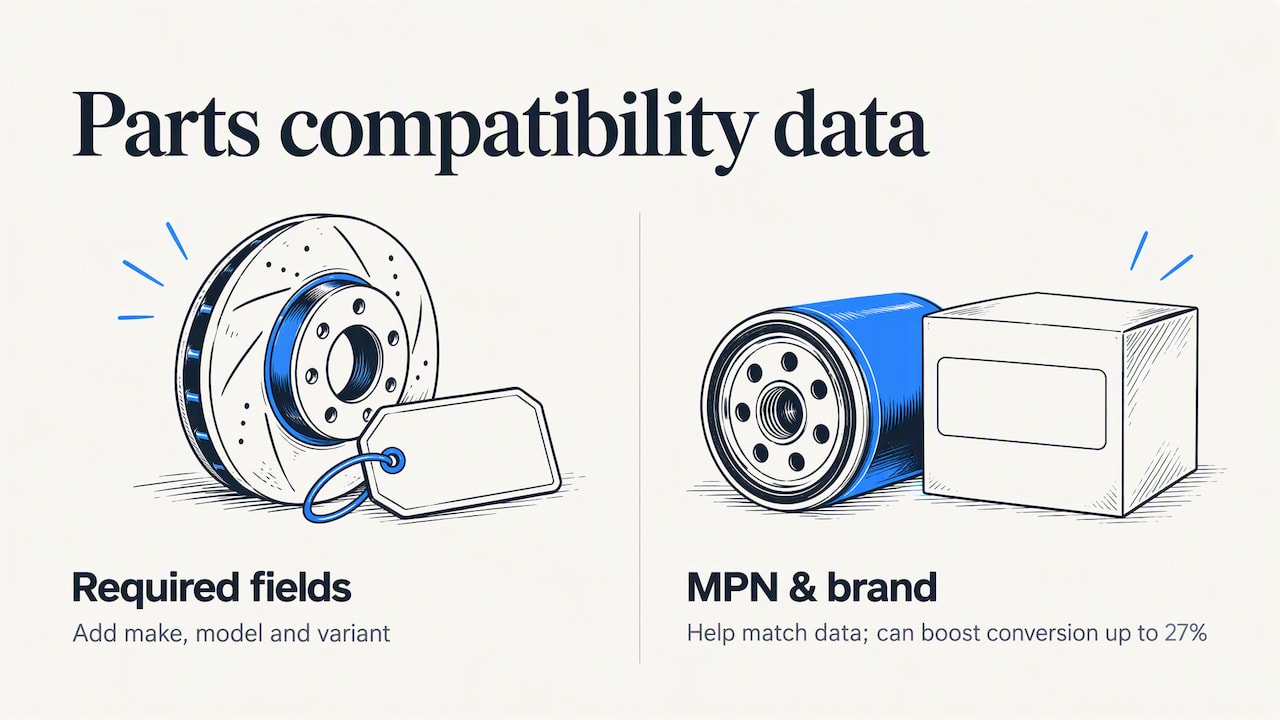
Fitment is the single largest source of avoidable returns for parts sellers. eBay's guidance on selling vehicle parts says to add compatible vehicles accurately, including at least make, model and variant, and notes that a correct MPN and brand help match product data and can boost conversion by up to 27%. That page is written for the UK, but the underlying principle applies to appliance and automotive parts alike: the buyer who can verify fit before buying rarely returns for fit.
Clear buyer communication
Buyers who ask "will this fit my washer?" before purchase are cheaper to serve than buyers who discover the answer after delivery. Reply quickly, quote model numbers in your answer and keep the exchange on eBay. Templates and automated replies help here, provided they are reviewed so they do not give wrong fitment advice.
When the return is not an honest one
Most returns are legitimate. A smaller share are not: an empty box sent back, a swapped item, a used item returned as "not as described." A restocking fee does not address these, and a 50% deduction rarely recovers the loss on a swapped unit. What helps is evidence and pattern recognition.
Our article on return fraud on eBay covers the response in detail, and the piece on what eBay seller protection covers and what it does not is useful for understanding where protection ends. For chargebacks specifically, see eBay chargeback protection for US sellers.
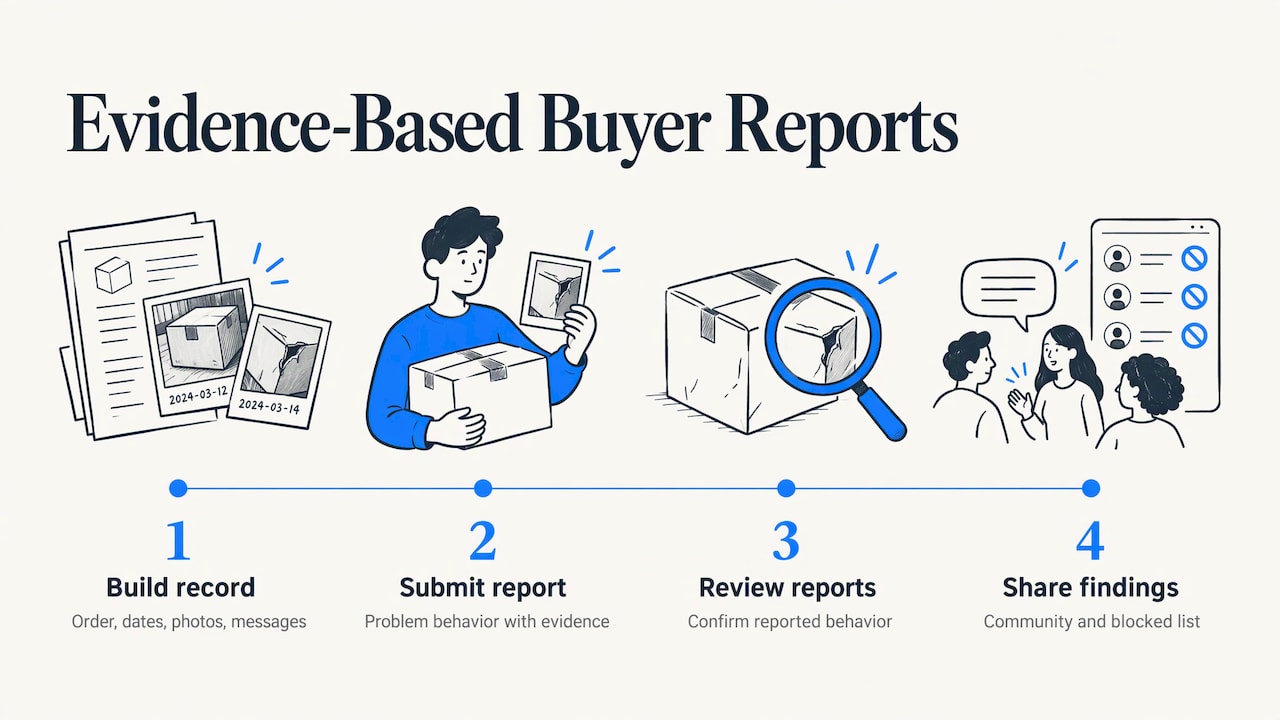
A record that includes the order, the dates, the photos and the buyer's messages is the foundation for any report, whether to eBay or to a community list.
What we think about restocking fees
We build tools for sellers who have been burned by returns, and the pattern we see is consistent: the restocking fee is a blunt instrument aimed at the wrong problem. An honest buyer who changes their mind is not the seller's main loss. The loss comes from a small group of repeat abusers who return used, swapped or damaged goods and then dispute the outcome.
Since 2008 sellers have not been able to leave negative feedback for buyers, so there is no public signal that a particular account has a history of this behavior. eBay's Blocked Buyers list lets you block an account after the fact, but it only reflects your own experience. That is the gap we designed SafeBay to address: sellers report problem behavior with evidence, reports are reviewed, and confirmed ones are shared with the community and synced to your eBay blocked list through the free Chrome extension.
We would rather a seller keep clean refund policies for the great majority of buyers and stop the repeat abusers before the next sale. Reasons and dates are kept with each entry, private and public blocks are separate, and appeals are supported, so the process is accountable for sellers and for buyers alike.
Mykola
Protect your account with SafeBay
If you are searching for restocking fees because a specific buyer is abusing your return policy, a fee is unlikely to solve it. SafeBay gives you a way to report an eBay buyer with evidence, check risk alerts on incoming orders and keep a shared buyer blacklist that syncs with eBay's Blocked Buyers list.
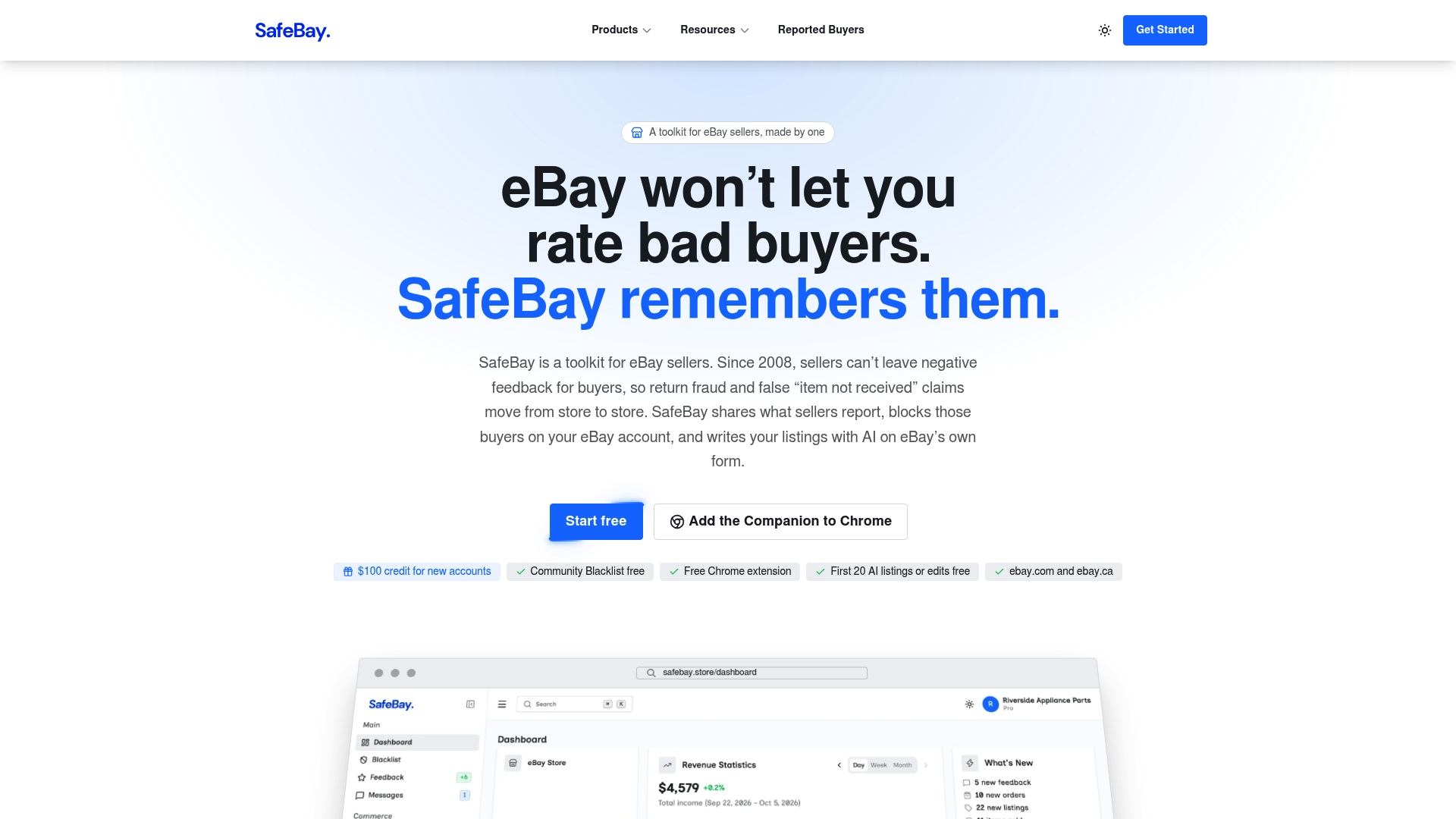
The plans on the SafeBay site are published as Free at $0 per month, Basic at $9.95 per month, Pro at $59.95 per month and Enterprise at $599.95 per month. The free plan includes basic features and limited AI usage, and the SafeBay Companion extension is free to install. You can read how return abuse protection works before you decide.
A short policy checklist for sellers
- Review your business policies in Seller Hub and confirm which return options your account offers.
- If you disclose any fee or deduction terms, state them plainly in the return-policy details.
- Use deductions only for actual lost value, never as a deterrent.
- Keep all messages and payments on eBay.
- Photograph outgoing and returned items for higher-value or fraud-prone categories.
- Refund within two business days of receiving the return.
- Report patterns of abuse rather than absorbing them.
FAQ
Can I charge a restocking fee on eBay as a US seller?
Not as a standard return-policy option: eBay.com removed it in May 2018. eBay's Seller Center still mentions a reasonable fee disclosed in the policy and a 15% cap for items needing substantial handling, but it advises against fees in general. Check what your account offers before relying on one.
What is the difference between a restocking fee and a deduction?
A restocking fee charges for the work of re-shelving an item, regardless of condition. A deduction recovers value lost when an item returns used, altered or damaged. eBay's help pages cap deductions at 50% and say they must not cover shipping or restocking costs.
Can I ask a buyer to pay a restocking fee through a payment app?
No. eBay's seller protections document treats taking a sale off eBay as abusive activity, and a side payment leaves you without a record or protection. Use the Returns dashboard and explain any deduction there.
Who pays return shipping on eBay?
For items not as described, eBay's Seller Center says the seller is responsible. For change-of-mind returns it depends on your return policy: if you offer free returns, you pay. A deduction cannot be used to recover shipping.
Sources
- eBay returns best practices, eBay Seller Center
- Top Rated returns, eBay Seller Center
- eBay.com Spring Seller Update 2018, ChannelX
- How to handle a return request as a seller, eBay
- Seller protections, eBay
- Seller protections abuse policy, eBay
- Seller Protections document, eBay Inc.
- Item description policy, eBay
- Sell vehicle parts, eBay Seller Centre