Your late shipment rate on eBay is the share of your transactions that eBay counts as shipped or delivered later than promised. In the United States, it decides whether you can hold Top Rated Seller status: the rate must stay at or below 3%, with no more than five late shipments in the evaluation period. This guide explains how the rate is calculated, which evaluation window applies to you, when eBay removes late marks automatically, and how to appeal the ones it leaves in place.
What the late shipment rate measures
eBay shows buyers an estimated delivery date for every order. The seller is responsible for dispatching within the handling time stated in the listing and for uploading valid tracking. The late shipment rate is the percentage of transactions in the evaluation period where that promise was missed, as defined in eBay's seller standards policy.
It is one of three metrics in the seller performance system, alongside transaction defect rate and cases closed without seller resolution. The evaluation cycle and the three metrics are the same across eBay's programs, although the requirement for each seller level differs by market. This article covers the United States.
Two points are easy to miss:
- The rate counts transactions, not items or dollars. One late order out of ten is a 10% rate for that small sample, whatever the order value.
- A late mark can come from either side of the promise: dispatch after the handling time, or delivery after the estimated date. The next section separates the two.
How eBay decides a shipment was late
The method depends on whether the order uses integrated carrier tracking.
Orders with integrated tracking
According to the seller standards policy, eBay counts a shipment as late when two conditions are both true: the carrier scan shows delivery after the estimated delivery date, and there is no carrier acceptance scan recorded within your stated handling time. If either condition fails, the shipment is not late. A package that the carrier accepted inside your handling window is protected even if the carrier then delivers it slowly.
This is why the first scan matters more than anything else. A label printed on Monday is worth nothing if the carrier does not scan the parcel until Thursday and your handling time was two days.
Orders without integrated tracking
When tracking cannot be verified, eBay relies on buyer feedback to establish whether the item arrived after the estimated delivery date. In practice, this makes manual tracking uploads and off-platform labels riskier: you lose the carrier data that would otherwise clear you.
Attempted delivery
eBay's automated systems treat an attempted delivery as a delivered event when calculating these metrics, so a buyer who was not home when the carrier came does not turn an on-time parcel into a late one, according to the defect appeal documentation.
Thresholds that matter in the US
The late shipment rate does not work like the defect rate. As of October 2026, it is not a factor in placing an account in the Below Standard level. It is, however, a primary requirement for Top Rated Seller status.
| Requirement | Threshold for Top Rated status (US) |
|---|---|
| Late shipment rate | 3% or less |
| Late shipments in the evaluation period | No more than 5 |
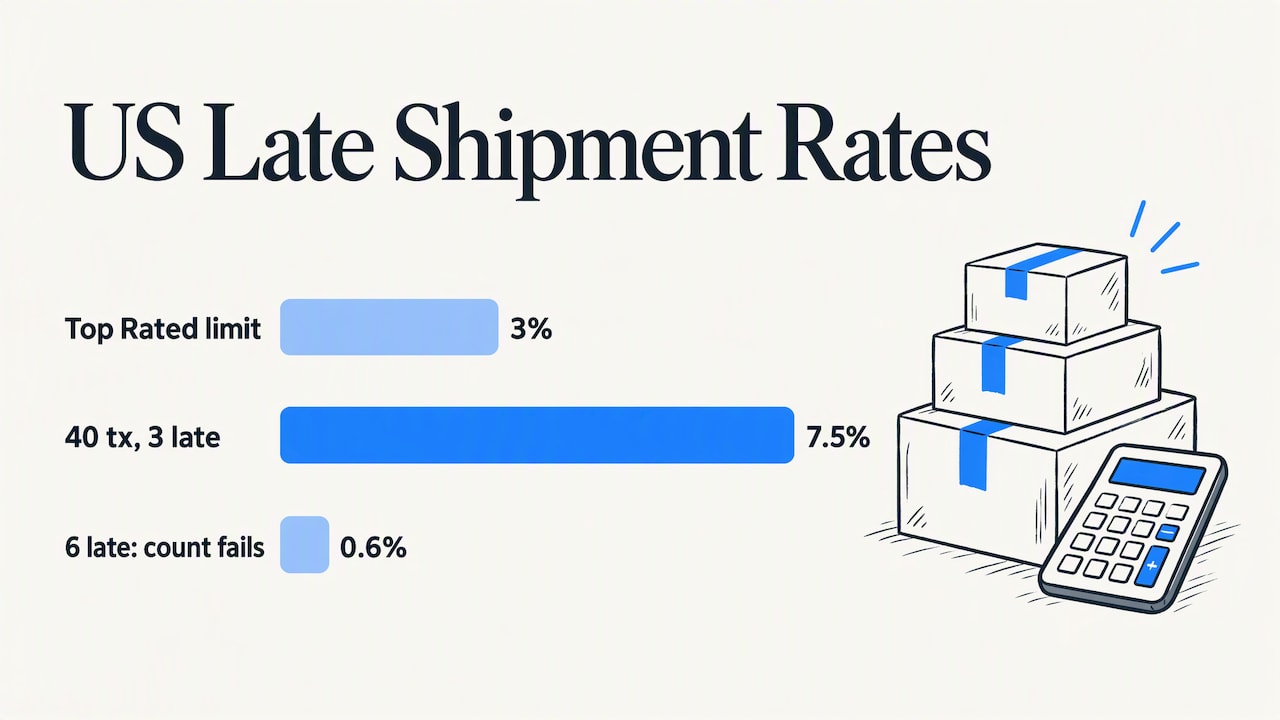
Both conditions must hold. A seller with 40 transactions in the window who has three late shipments has a 7.5% rate, even though the count is under five. A seller with 1,000 transactions who has six late shipments has a 0.6% rate, but the count still exceeds the cap. The rule that is stricter for your volume is the one that binds.
For the wider picture of how this metric combines with defects and case rates, see our guide to eBay seller levels and how to move up.
Which evaluation period applies to you
eBay adjusts the look-back window by sales volume so that every seller is judged on a meaningful sample:
- 400 or more transactions over 3 months: you are evaluated on that 3-month window.
- Fewer than 400 transactions over 3 months: you are evaluated on the preceding 12 months.
The consequence differs sharply by seller type. A high-volume seller can recover in a quarter, because bad weeks age out quickly. A small seller carries one bad month for a full year, and each late order weighs more heavily because the denominator is small.
A worked example
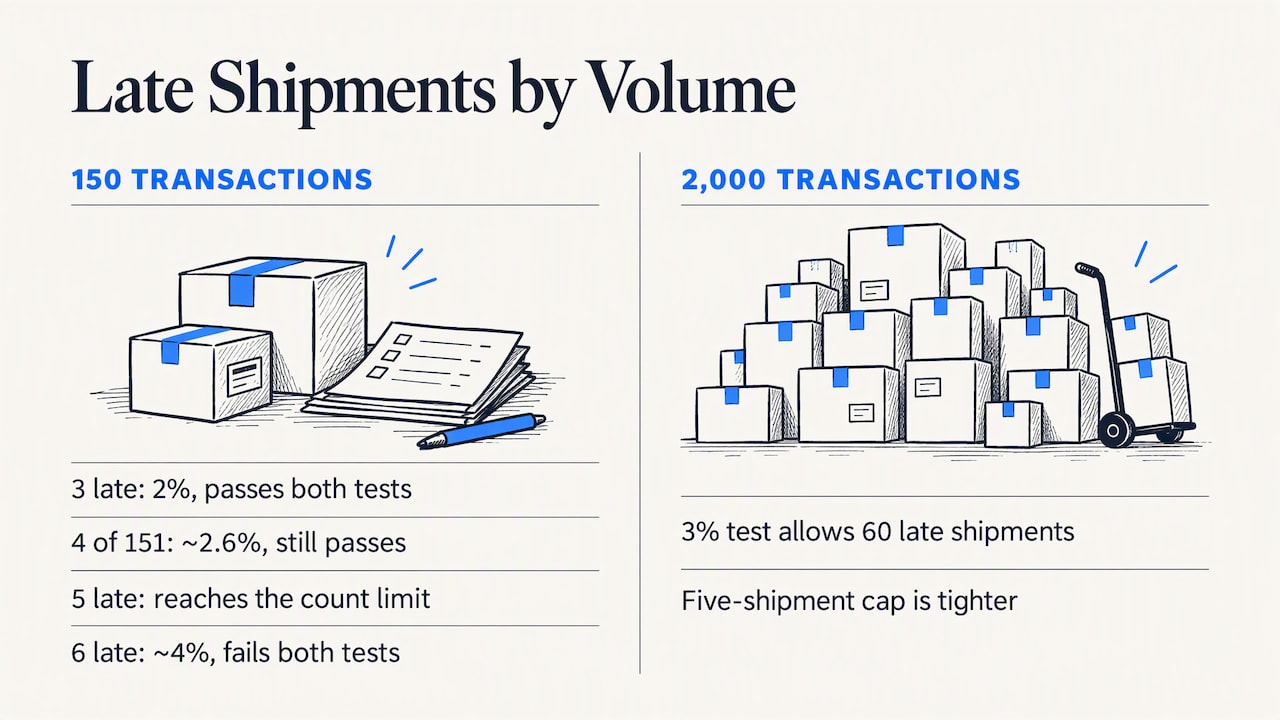
Take a part-time seller with 150 transactions in the last 12 months and 3 late shipments. The rate is 2%, which passes the 3% test, and the count is under five. One more late order makes it 4 of 151, or about 2.6%, which still passes. A fifth keeps the count at the cap, and a sixth breaks it even though the percentage is only around 4%, and it would also cross the 3% line. At low volume, the cap and the percentage tighten together, so each late order deserves attention.
Now take a seller with 2,000 transactions over 3 months. Three percent allows 60 late shipments on the percentage test, but the five-shipment cap in the Top Rated requirement is the tighter limit. Check the exact wording of both conditions in your Seller Hub before relying on arithmetic alone.
When eBay removes late marks automatically
eBay acknowledges that logistics can fail for reasons a seller cannot control. The appeal documentation states that eBay removes defects and late shipments automatically in a range of situations, for example widespread weather events it is aware of, or eBay site issues that interrupted a transaction.
The practical rule: do not appeal immediately. eBay reconciles tracking and delivery data daily, and the automatic removal can lag. Wait at least 72 hours after the problem before filing a manual appeal, otherwise you create work for yourself on a mark the system would have corrected.
How to appeal a late shipment
If a late mark remains after the waiting period, you can appeal it. The window is 90 days from the transaction date, and eBay will remove the mark when you provide evidence that tracking was uploaded before the latest estimated delivery date and shows the package was dispatched within the handling time or delivered by the estimated date, per the appeal policy.
A workable sequence:
- Open the transaction in Seller Hub and confirm the mark is still present after 72 hours.
- Pull the carrier tracking history and note the timestamp of the first acceptance scan against your handling deadline.
- Compare the upload time of the tracking number with the latest estimated delivery date.
- If both support you, file the appeal and attach the tracking evidence.
- If the carrier shows delivery after the estimated date but the acceptance scan was on time, say so explicitly, because that combination should not count as late.
- Record the outcome so you can see which carriers or products repeat the problem.
High-value orders
For orders above a total of $750 in the US, eBay expects proof of delivery by signature confirmation if you need a manual late delivery removal and standard tracking does not show on-time status. Adding signature confirmation to expensive orders costs a few dollars and removes an argument you would otherwise lose.
Carrier scan problems
Mentor forum threads from sellers describe cases where USPS tracking did not update properly after the move to Ground Advantage, which produced late marks on parcels sent on time. The appeal route above is built for exactly this case: the evidence is the acceptance scan, so photograph the drop-off receipt or request a scan form when you hand parcels to the carrier in bulk.
Why sellers get late marks
Most late marks trace back to a small number of causes, and most are workflow problems rather than carrier problems.
- Handling time set too short. Sellers choose same-day or one-day handling to win placement or a program badge, then miss it during busy weeks. A two-day promise you meet is worth more than a one-day promise you meet 90% of the time.
- Dropshipping or supplier delay. If a supplier needs two or three days to ship, the handling time on the listing must include that.
- Parcels dropped late in the day. The carrier scans them the next morning, after the deadline.
- Tracking uploaded manually and late. Even when the parcel shipped on time, the delay in the record can create doubt.
- Out-of-stock items. Cancelling is a different defect, but delaying while you search for stock produces late shipments.
- Vacations and holidays. Handling time counts business days, so build leave into your listings or use time away settings.
A weekly routine to keep the rate low
- Audit your handling times. Compare the actual dispatch time of your last 50 orders to the promise in each listing. Raise the promise where the gap is regular.
- Set a fixed carrier drop time. Schedule a pickup or a drop-off early enough for a same-day scan.
- Buy labels through eBay. Integrated tracking gives eBay the data it needs to clear you.
- Check Seller Hub weekly. The rate moves slowly, and you want to see a late order within days, not at the end of the evaluation period.
- Appeal in a batch. After 72 hours, review all open marks together and file with evidence.
- Protect against delayed requests. If a buyer asks for delayed shipping, document it in messages and adjust the dispatch plan. For a low-volume seller, a single late order can move the percentage noticeably.
Where buyer behavior intersects with shipping performance
Late shipment marks are a seller's own responsibility, but not every problem in the metrics comes from your process. Some buyers claim items never arrived, open cases on delivered parcels, or leave feedback that contradicts the tracking record. Those events feed the other two metrics, and they can compound a bad month.
Two practical steps help. First, review a buyer's profile and risk signals before shipping a high-value order: our list of buyer red flags to check before you ship covers the warning signs. Second, if a transaction goes wrong, act quickly: we cover the timing that matters for seller scams in a separate guide.
Our perspective
We built SafeBay around a problem that sellers have raised for years: since 2008, eBay sellers have not been able to leave negative feedback for problematic buyers, and the result is repeat return fraud and false claims. That gap matters for this topic because shipping metrics are one of three scores that decide a seller's standing, and a seller's own conduct is the part they control completely.
Our advice is to separate what you can fix from what you can only contain. Late shipments are in the first group. They respond to honest handling times, a fixed drop-off routine and evidence-based appeals, and none of that needs a tool. Buyer abuse belongs in the second group. There, the useful measure is to avoid shipping to the same problem buyer twice, and that is where a shared, evidence-based blocklist is relevant.
We would also caution against reading the late shipment rate as a pure speed contest. It is a promise-keeping metric. Sellers who promise less and deliver it hold the better rate, and they lose very little in conversion, because the estimated delivery date that buyers see is built from the handling time plus carrier transit.
— Mykola
How SafeBay fits into this workflow
SafeBay does not change how eBay counts shipments, and no tool can. What it supports is the part of the workflow around the shipment: a community-reviewed buyer blacklist that syncs to your eBay Blocked Buyers list through the free Chrome extension, real-time buyer risk alerts, and automated AI replies for buyer messages and feedback, so routine questions about shipping status do not wait for you.
The Free plan costs $0 per month and covers the basic features with limited AI usage. Paid plans are Basic at $9.95 per month, Pro at $59.95 per month and Enterprise at $599.95 per month. You can compare them on the SafeBay plans page, or check how a buyer looks before you ship. If you want to see how automation of replies works, read how to automate eBay feedback in both directions.
Common mistakes
- Appealing within hours. The system may already be correcting the record.
- Ignoring the 90-day limit. After it passes, a valid case can no longer be filed.
- Treating one late order as harmless at low volume. In a 12-month window of 100 or so transactions, it is a full percentage point.
- Assuming the carrier is always the cause. Check the acceptance scan first. If it is late, the appeal will fail.
- Skipping signature confirmation on orders above $750.
- Confusing the metric with seller protection. Shipping on time and having tracking uploaded are conditions for protection in disputes, as covered in our guide to what eBay Seller Protection covers.
FAQ
What happens if I ship an item late on eBay?
The transaction can count toward your late shipment rate if the carrier acceptance scan is missing within the handling time and the delivery arrives after the estimated date. One or two late orders are rarely serious for a high-volume seller. For a seller with few transactions, they can push the rate above the 3% limit for Top Rated status.
What late shipment rate do I need to be Top Rated in the US?
The rate must be 3% or less, with no more than five late shipments in the evaluation period, according to eBay's seller standards policy. Other Top Rated requirements, such as defect and case rates, apply as well.
Can a late shipment rate put me at Below Standard?
As of October 2026, the late shipment rate is not a factor in determining whether an account is Below Standard. It is a primary metric for Top Rated status. Your defect rate and cases closed without resolution are the metrics that drive the lower level.
How long do I have to appeal a late shipment?
You have 90 days from the transaction date. Wait at least 72 hours before filing so that eBay's daily automatic reconciliation can remove the mark first, then attach tracking evidence showing on-time dispatch or delivery.
Does a failed delivery attempt count as a late delivery?
No. eBay's automated systems treat an attempted delivery as a delivered event in these calculations, so the seller is not penalized for a buyer who was unavailable.