
eBay assigns every seller one of three levels, Top Rated, Above Standard or Below Standard, and recalculates it once a month from three measures: cases closed without seller resolution, transaction defect rate and late shipment rate. The level affects search visibility, protections and, at the bottom end, whether eBay restricts your account. This guide explains what each level requires, when and how the evaluation runs, why a single bad buyer can still damage your numbers, and what a sensible routine looks like.
TL;DR
- There are three levels in the US: Top Rated, Above Standard and Below Standard. eBay evaluates them monthly, on the 20th.
- Three metrics drive the result: cases closed without seller resolution, transaction defect rate and late shipment rate.
- Top Rated needs at least 100 transactions and $1,000 in sales to US buyers in 12 months, plus a defect rate of 0.5% or less and late shipments of 3% or less.
- Below Standard can bring payment holds, limits on promoted listings and selling limits, so unresolved buyer disputes are worth preventing early.
- Levels are program-specific by region, and your detailed metrics are private.
Table of Contents
- What eBay seller levels are
- The three levels compared
- The three metrics that decide your level
- When and how eBay evaluates you
- Regional programs and privacy of your metrics
- Requirements for Top Rated status, step by step
- Why Below Standard is worth avoiding
- How to raise or protect your level
- Our perspective on seller levels
- Where SafeBay fits
- Common mistakes that cost sellers their level
- FAQ
- Sources
What eBay seller levels are
A seller level is a label eBay attaches to your account after comparing your recent performance with its minimum standards. eBay describes it as an indication of whether you are meeting or exceeding those standards. It is not a measure of how long you have sold or how much you earn. Experienced sellers sometimes assume tenure counts for something, but the level is determined by your results, not by your age on the platform.
The system exists to reward consistent customer service. According to eBay's Seller Centre, Above Standard and Top Rated status come with tangible advantages such as better visibility in search results and stronger seller protections, while Below Standard status can lead to payment holds, restricted access to promoted listings and account-wide selling limits. The consequences are therefore commercial rather than cosmetic.
Two related terms are worth separating at the start:
- Seller standards is the program that produces your level (Top Rated, Above Standard, Below Standard).
- Service metrics is a separate evaluation that eBay also runs. The seller standards policy itself notes that service metrics are another way eBay evaluates performance, and the detailed seller ratings buyers leave feed that side of the picture.
The three levels compared
| Level | What it signals | Key requirements | What follows |
|---|---|---|---|
| Top Rated | Consistently strong service | 100+ transactions and $1,000+ in US sales over 12 months, defect rate 0.5% or less, cases closed without seller resolution 0.3% or less, late shipments 3% or less | Badge, extra visibility and benefits |
| Above Standard | Meets eBay's minimums | Defects within the allowed 2% of transactions, plus on-time shipping | Normal selling access |
| Below Standard | Falls short of minimums | Defects or late shipments above the allowed limit | Possible payment holds, promoted listing restrictions and selling limits |
The Top Rated figures come from eBay's Top Rated program page, which also requires an account active for at least 90 days and compliance with selling policies. The 2% defect allowance for the baseline comes from the seller standards policy. Check that policy for the current late shipment ceiling for Below Standard, because eBay adjusts thresholds from time to time and we would rather you read the live number than a copy of it.
The three metrics that decide your level
Cases closed without seller resolution
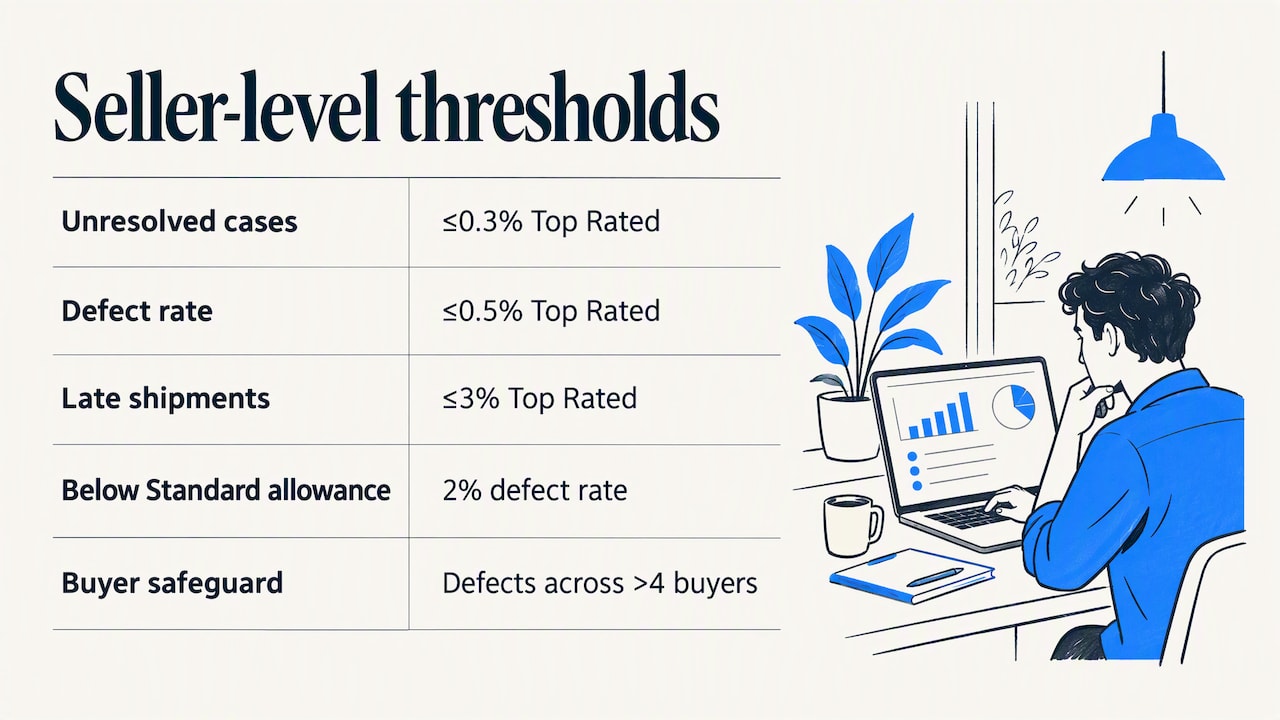
When a buyer opens an issue, such as an item not received or not as described, and the seller does not resolve it, eBay may step in and close the case in the buyer's favor. That counts against you. For Top Rated, the threshold is 0.3% or less. On a small catalog, a single such case can move the percentage visibly, which is why speed and clarity in the first reply matter more than winning an argument.
Transaction defect rate
eBay counts a defect when the seller cancels an order unexpectedly, for example because the item was out of stock or sold elsewhere, or when the buyer reports an issue that the seller does not resolve. The policy allows up to 2% of transactions with defects in an evaluation period. It also adds a safeguard: you are only evaluated as Below Standard if the defects involve more than 4 different buyers. A single difficult buyer who files several claims therefore cannot, on his own, push you down under that rule.
For Top Rated, the defect rate must be 0.5% or less.
Late shipment rate
EBay shows buyers an estimated delivery date, and sellers are responsible for uploading tracking within the handling time they promised. Top Rated requires a late shipment rate of 3% or less. Rigid processing schedules are the practical fix: experienced sellers consistently describe fixed daily packing and tracking upload routines as the way to avoid lateness, along with enough stock to avoid cancellations.
When and how eBay evaluates you
eBay runs the evaluation on the 20th of each month. According to the seller standards policy, the sample depends on your volume:
- With more than 400 transactions in the past 3 months, eBay counts all of those.
- With fewer than 400 transactions in the past 3 months, eBay counts your transactions from the last 12 months.
This explains a common source of confusion on seller forums: a bad month does not show up the next day, and a good month does not fix your level instantly. Sellers with modest volume carry a full year of history, so one unresolved case lingers. Sellers with high volume are judged on a shorter, fresher window.
One dated change is worth noting. The same policy states that beginning October 15, 2026, eBay Live transactions no longer count toward seller standards or service metrics, including those completed before that date, and that eBay Live performance will be evaluated separately under a future program. If you sell through eBay Live, expect your numbers to shift on the next evaluation.
Regional programs and privacy of your metrics
Levels are not global. eBay operates four regional seller standards programs based on the country an item ships to, so you can hold Top Rated on one site and Above Standard on eBay.com at the same time. If you sell internationally, track each program separately instead of assuming a US result applies elsewhere.
Buyers see the badge but not the detail. Your defect and late shipment percentages remain private, which means you cannot judge how close a competitor is to a downgrade, and they cannot judge you. Your own Seller Hub is the only place to see how close you are to a threshold.
Requirements for Top Rated status, step by step
- Confirm the basics. The account needs to be active for at least 90 days and comply with selling policies, per eBay's program page.
- Reach the volume floor. You need at least 100 transactions and $1,000 in sales to US buyers in the previous 12 months. Low-ticket sellers hit the transaction count before the dollar figure, and vice versa for high-ticket sellers.
- Hold the three ratios. Defect rate of 0.5% or less, cases closed without seller resolution of 0.3% or less, and late shipments of 3% or less.
- Wait for the cycle. Since evaluation occurs monthly, plan on at least one evaluation date before any improvement shows as a new level.
The ratios are demanding in small samples. At 200 transactions in the evaluation window, 0.5% is a single defective transaction, and 0.3% is less than one case. That is arithmetic rather than a rule from eBay, but it shows why sellers on small catalogs treat every dispute as significant.
Why Below Standard is worth avoiding
The listed consequences, payment holds, restricted promoted listings access and selling limits, hit cash flow and visibility at once. Payment holds delay money you have already earned, and selling limits cap the growth you were planning for.
Sellers sometimes respond by looking at other channels. If you carry specialty inventory, say heavy equipment attachments, it can be reasonable to compare how other marketplaces handle your category, but a second channel does not repair a weak eBay level. Fixing the cause is usually faster and cheaper.
How to raise or protect your level
Prevent cancellations
Seller-initiated cancellations count as defects. Keep inventory counts accurate, remove listings promptly when stock is gone, and avoid listing items you do not physically hold unless your supplier's availability is reliable. Automatic relisting is useful for ended items, but only when inventory truly remains.
Ship inside the promised window
Set handling time you can meet on your worst day, not your best. Upload tracking at the time of label purchase, not in a batch later.
Resolve buyer issues before they become cases
An early, specific reply often prevents a case from being opened at all. Experienced sellers advise responding to inquiries with precision so minor issues do not become defect-triggering cases. Offering a partial refund or a return can cost less than a case closed against you.
Screen the buyers who cause the problem
Most sellers lose their level less through honest mistakes than through a small number of buyers who file false claims or abuse returns. Our guide to warning signs before you ship lists the patterns worth checking, and the broader question of whether eBay's own tools are enough is covered in why the blocked buyer list falls short.
Our perspective on seller levels
We build tools for eBay sellers, and the pattern we see is consistent: the metrics that decide a seller level are treated as the seller's own responsibility, yet one of the largest causes of damage sits outside the seller's control. Since 2008, sellers have been unable to leave negative feedback for problematic buyers. That left return fraud and false claims with little visible consequence for the buyer, while the seller absorbs the effect in defect rates and unresolved cases.
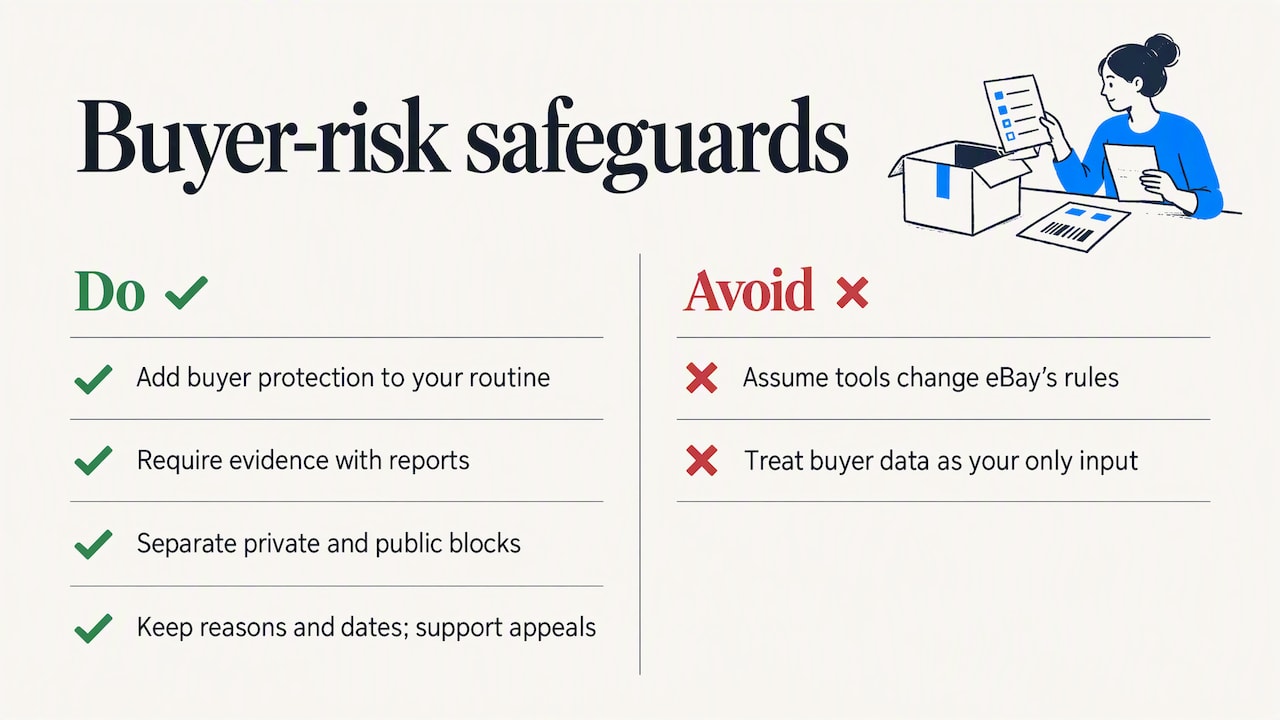
The safeguard that requires defects across more than 4 different buyers helps, but it does not remove the risk. A seller with low volume, whose evaluation spans twelve months, can still be hurt by a few repeat claimants. For that reason we think protection against problem buyers belongs in the same routine as shipping discipline and inventory accuracy, not as a separate afterthought.
We also suggest a measured approach. No tool changes eBay's rules or guarantees a level, and a community blacklist is only as useful as its evidence and appeals process. That is why SafeBay requires reports to carry evidence, separates private blocks from public ones, keeps the reasons and dates, and supports appeals. Treat any buyer data, ours included, as one input to your own judgment.
— Mykola
Where SafeBay fits
SafeBay is a toolkit for eBay sellers that includes a community-reviewed buyer blacklist, real-time buyer risk alerts and syncing to your eBay Blocked Buyers list through the free SafeBay Companion Chrome extension. You can look up a buyer's status on the buyer check page and submit your own evidence through the report form. Alongside protection, it offers AI listing generation, automated messages and sales analytics. The Free plan costs $0 per month with limited AI usage, Basic is $9.95 per month, Pro is $59.95 per month and Enterprise is $599.95 per month; the plans are listed on our homepage.
Common mistakes that cost sellers their level
- Ignoring the evaluation cycle. Fixing a problem on the 25th does not alter the evaluation already run on the 20th.
- Treating all defects as equal. Cancellations are the most preventable category, since they come from your own stock management.
- Arguing a claim rather than closing it. A resolved case does not count against you in the same way as one closed without seller resolution.
- Assuming a level carries across regions. Each regional program stands alone.
- Not reading the policy again. Thresholds and treatment of specific sales types, such as eBay Live from October 15, 2026, can change.
FAQ
How many seller levels does eBay have?
In the US there are three: Top Rated, Above Standard and Below Standard. Each is assigned from your recent performance and recalculated monthly. Your level shows in Seller Hub, and Top Rated sellers also carry a public badge.
How do I increase my seller level on eBay?
Lower your defect rate, ship every order inside the promised handling time and settle buyer issues before they close as cases without seller resolution. Since eBay evaluates on the 20th of each month, improvement appears at the next cycle rather than immediately. Keep inventory counts accurate to avoid cancellations.
What are the requirements for Top Rated status?
An account active for at least 90 days, policy compliance, and at least 100 transactions with $1,000 in sales to US buyers over the past 12 months. The ratios must be a defect rate of 0.5% or less, cases closed without seller resolution of 0.3% or less and late shipments of 3% or less, per eBay's program page.
Can other sellers see my defect rate?
No. Buyers and competitors see your badge and feedback, but your service metrics stay private. You can only read them in your own account.
Sources
- Seller standards policy, eBay US
- Top Rated Seller Program, eBay Seller Centre
- Seller Standards, eBay UK Seller Centre
- Global seller performance policy, eBay
- Seller performance overview, eBay
- Seller performance concepts and management, eBay Korea