A feedback revision request is a formal message, sent through eBay, that asks a buyer to reconsider a negative or neutral rating after you have resolved the underlying problem. You can send it only while the feedback is less than 30 days old, you get a limited number per year, and the buyer decides whether to change anything. This guide covers the steps, the wording, what happens afterward, and the alternatives when the buyer declines.
What a feedback revision request does and does not do
Sellers cannot edit a buyer's feedback, and a buyer cannot change it without a prompt from you. The request is the only built-in way to ask for a change. According to eBay's help page on responding to feedback, the sensible order is to contact the buyer first, address the specific issue, and only then ask whether they will revise their rating and comment.
The request is meant for negative or neutral feedback. It is not a tool for rewording a positive rating, and sellers who spend a request on positive feedback use up part of a small annual allowance for no benefit.
Two points shape how you should treat it:
- It is a request, not a claim. The buyer can accept or decline, and a decline carries no penalty for either side.
- A revision replaces the original. When a buyer revises feedback, the original comments are no longer visible on eBay, so a successful request removes the earlier text and rating from your profile.
It also helps to keep the stakes in proportion. eBay's feedback policy states that negative or neutral feedback does not affect seller performance, although it still shapes how prospective buyers read your profile. That is a reason to handle the request carefully rather than urgently.
Limits and deadlines to know before you send
The U.S. seller help page sets out the rules in a few lines, and they are strict enough that planning matters.
| Rule | What eBay says |
|---|---|
| Age of feedback | Less than 30 days old |
| Standard allowance | 5 requests per calendar year |
| Volume bonus | 5 additional requests for every 1,000 feedback ratings received during the year |
| Carry-over | Additional requests do not carry over to the next year |
| Buyer response time | 10 days to revise or decline |
The allowance and the 30-day limit come from eBay's page on replying to feedback you received, and the 10-day response period comes from eBay's guide to responding to buyer feedback.
The practical consequence is that five requests per year is a small budget for a seller with steady volume. Spend them on cases where you have actually fixed something: a refund issued, a replacement shipped, a misunderstanding about delivery cleared up. A request sent while the dispute is still open usually fails and costs you one of the five.
How to send a feedback revision request step by step
The exact menu labels on eBay change from time to time, so treat the sequence below as the pattern and check eBay's page for the current route.
- Confirm the feedback is eligible. Open your feedback profile and check that the rating is negative or neutral and that it is less than 30 days old.
- Resolve the issue first. Refund, replace, or clarify before you ask for anything. A request that arrives after a fix reads as a follow-up, while one that arrives with no fix reads as pressure.
- Use the "Request a feedback revision" option. eBay's official page provides this route directly for the feedback you received.
- Submit the request. eBay sends the buyer an email with all the details, so you do not need to write a long explanation in the form itself.
- Wait the full 10 days. Do not send repeated messages in the meantime. If the buyer accepts, eBay guides them through changing the rating and comment.
If you have sold on eBay for a while, you will notice that the request itself carries little explanation. That is why a short, courteous message through eBay messaging, sent before or alongside the request, tends to matter more than the form.
What to say to the buyer without pressuring them
eBay's feedback policy is aimed at honest ratings, and a revision request should never read as a condition. Offering a refund only if the buyer changes their feedback, or threatening consequences, crosses into feedback manipulation. Our guide to feedback extortion on eBay covers the opposite direction, where a buyer demands something in return for a rating, and the same principle applies to you: keep the resolution and the rating separate.
A message that works generally has four parts:
- Acknowledge the problem. Name the specific issue, for example a late delivery or a part that did not fit.
- State what you did. Say what has been refunded, replaced or corrected, and when.
- Make the request once. Say that a revision request may arrive by email and that the decision is theirs.
- Close politely. Thank them, with no deadline and no follow-up threat.
A sample you can adapt:
Hello, thank you for your order and for letting us know the item arrived late. We have issued the refund for shipping, and we are sorry for the delay. If you feel the issue has been resolved, you may receive a feedback revision request from eBay. Whether to change your feedback is entirely up to you, and we appreciate your time either way.
Two habits keep the tone right. First, never mention the rating in the same sentence as the refund. Second, never send the message from outside eBay messaging, because eBay's policy restricts moving the conversation off the platform and you want a record. If you handle many messages, the free eBay feedback generator can draft wording for you to edit before sending.
What happens after the request is sent
Once submitted, the buyer has 10 days to respond in one of two ways, as eBay describes:
- Revise. eBay guides the buyer through changing the rating and comment, and the original comments are replaced.
- Decline. The buyer can choose whether to share their reasoning with you.
When the buyer simply does not respond, the request lapses at the end of the window and the original feedback stays. You should not treat silence as a reason to resend, since the request cannot be repeated at will and each one counts against your annual allowance.
If the buyer declines: reply publicly
A decline is not the end of the matter. eBay recommends leaving a reply that gives your version of events or adds context. The reply appears directly below the buyer's feedback, so every future buyer who reads it sees both sides.
A good public reply has these traits:
- Short and factual. Two or three sentences are enough.
- Specific. State what happened and what you did, such as the refund date or the replacement shipped.
- Free of accusation. Do not call the buyer dishonest, even if you suspect it.
- Written for the next buyer. The audience is a prospective customer reading your profile, not the person who left the rating.
Example: "Item shipped the day after purchase with tracking. Carrier delay confirmed, and we refunded the shipping cost. Please contact us with any questions."
For a broader view of how reply tone shapes perception, this overview of how buyer and seller ratings shape trust explains why a small number of ratings can move a profile's impression more than sellers expect. If you answer a lot of feedback, our overview of how to automate eBay feedback in both directions describes how to keep replies consistent without writing each from scratch.
When removal is a better route than revision
Some feedback should not be negotiated at all. If it violates eBay's rules, you can ask eBay to take it down. The feedback policy lets sellers request removal through Seller Help within 90 days when feedback appears to break policy, for example when it contains threats, personal information, links to off-eBay sales, manipulation, or irrelevant content. eBay reviews cases that are not clear-cut manually.
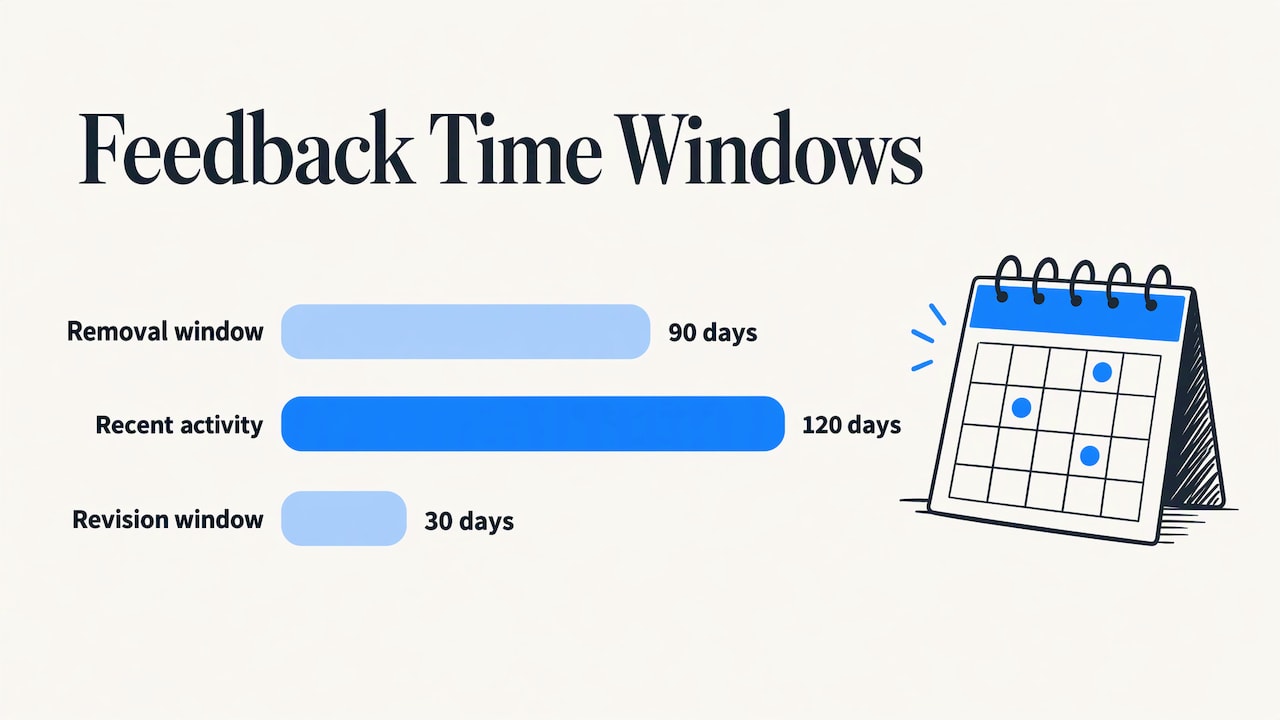
Access to this route depends on recent activity. According to eBay's Seller Help page, it is available to sellers who listed or sold an item within the past 120 days, and it includes a request assistance area for removal of negative or neutral feedback.
A simple way to choose between the routes:
| Situation | Better route |
|---|---|
| Genuine complaint you have since fixed | Revision request, within 30 days |
| Buyer declined, complaint was real | Public reply |
| Feedback contains threats or personal data | Removal through Seller Help |
| Feedback demands payment or something else for a change | Removal through Seller Help, with evidence saved |
| Feedback unrelated to the item or service | Removal through Seller Help |
Our guide to checking eligibility before filing for feedback removal walks through which cases qualify, and the guide to an item not as described claim helps when the negative rating follows a dispute about the listing. For rating problems that begin with a non-paying buyer, read what sellers should do about an unpaid item.
Preventing the next negative rating
Revision requests are a limited resource, so the larger gain comes from reducing the situations that lead to them. Three habits cover most cases:
- Accurate listings. Many negative ratings trace to a mismatch between the description and the item. Tools such as the free listing analyzer score a listing before you publish it.
- Fast first response. A prompt answer to a question or complaint often settles the matter before a rating is left.
- Screening repeat problem accounts. Some buyers make a pattern of disputes. You can check a buyer's status before shipping a high-value order.
Our perspective
Since 2008, sellers have had no way to leave negative feedback for buyers, and that imbalance explains why so much effort goes into revision requests, replies and removal cases. The seller can only react after the rating exists, with five requests a year and a 30-day window.
We built SafeBay around the view that prevention should come before repair. A community-reviewed buyer blacklist, where reports carry evidence, reasons and dates, lets sellers act on a pattern of behavior before the next dispute starts. Private and public blocks stay separate, and appeals exist, so a block remains accountable instead of arbitrary.
The same reasoning applies to replies. A consistent, factual response to every piece of feedback does more for a profile than an occasional emergency request, and AI drafting inside eBay's own workflow makes that consistency realistic for a busy store.
Mykola
Protecting your account with SafeBay
If revision requests are becoming a recurring chore, the underlying issue is usually a small group of buyers who generate disputes. SafeBay combines a community-reviewed buyer blacklist, risk alerts and syncing to your eBay Blocked Buyers list through the free Chrome extension, with AI tools for listings, messages and feedback replies. The Free plan costs $0 per month, Basic is $9.95 per month, Pro is $59.95 per month and Enterprise is $599.95 per month. You can compare the plans on the SafeBay plans page or look at the SafeBay Companion extension.
You can also read how the community buyer blacklist works, or report a problem buyer with your evidence so other sellers benefit.
FAQ
How long do I have to send a feedback revision request on eBay?
You can send it while the feedback is less than 30 days old, according to eBay's seller help page. After that, the request option is no longer available for that rating. Public replies and removal requests for policy violations follow separate rules.
How many revision requests can a seller send?
The standard allowance is 5 per calendar year, with 5 additional requests for every 1,000 feedback ratings you receive during the year. Additional requests do not carry over into the next year. Use them only after you have resolved the buyer's issue.
What if the buyer ignores or declines the request?
The buyer has 10 days to revise or decline, and if they decline they may or may not explain why. The original feedback then stays on your profile. Leave a short, factual public reply, and request removal through Seller Help only if the feedback breaks eBay's policy.
Can I ask eBay to remove negative feedback instead?
Yes, when the feedback appears to violate eBay's feedback policy, such as threats, personal information or off-eBay sales links. Seller Help accepts these requests within 90 days, and eBay manually reviews cases that are not clear-cut. A fair but unfavorable rating generally does not qualify.