
An empty box return on eBay comes in two forms: the buyer claims the package arrived with nothing inside, or the buyer requests a return and ships back an empty box. In both cases the outcome depends on the documentation you can produce, on how you handle the case inside eBay, and on whether the buyer is allowed to repeat the pattern on your account. Sellers cannot leave negative feedback for buyers, so the last part needs a system of its own: SafeBay's community blacklist, synced to your eBay Blocked Buyers list through the free SafeBay Companion extension, is built for that step.
What an empty box claim actually is
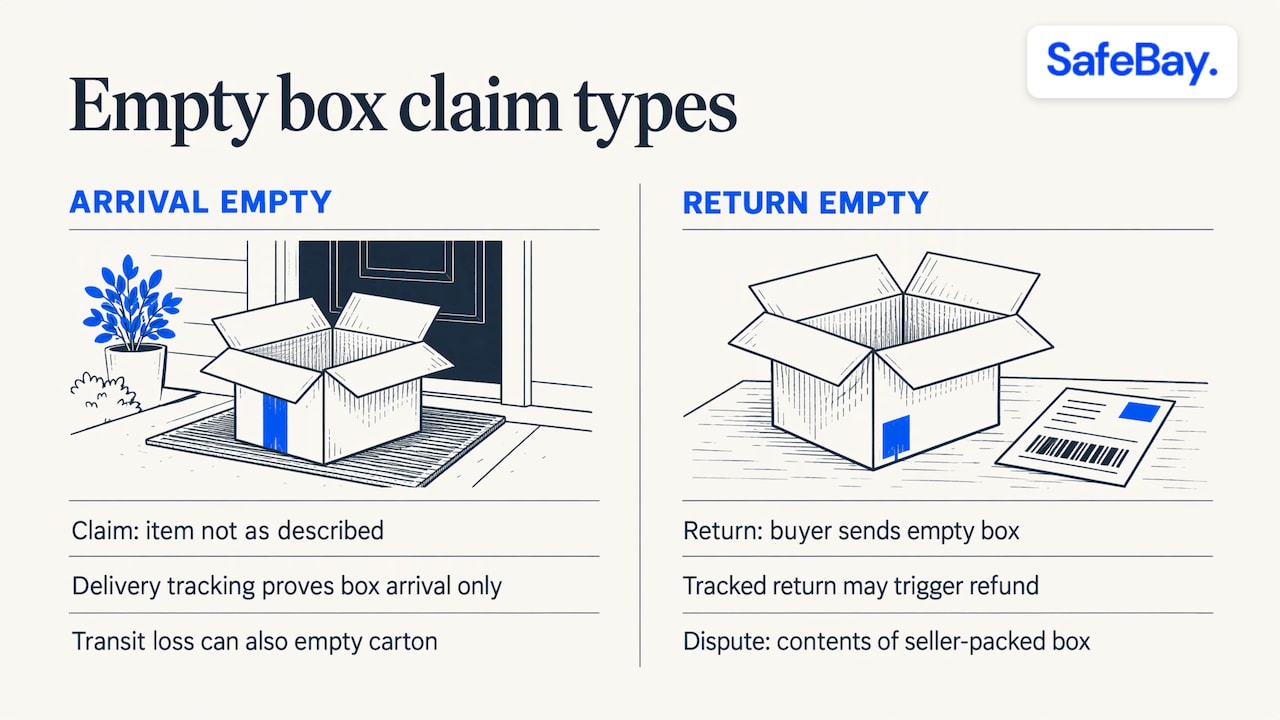
The label covers two different situations, and the response differs for each.
The buyer says the package arrived empty. eBay's Money Back Guarantee policy tells buyers to accept delivery and report that the item does not match the listing when a package arrives empty or damaged in transit. That means the claim is processed as "not as described," not as "item not received." Your tracking showing a successful delivery, which normally protects you against a not-received claim, does not settle this question by itself, because nobody disputes that a box arrived.
The buyer returns an empty box. Auction Nudge's guide to return fraud describes this second variation: the buyer requests a return and then simply sends back an empty box, hoping the tracked return triggers an automatic refund. Here the dispute is about what was inside a package you did not pack.
Neither is the same as genuine transit loss. A torn carton can let an item fall out, and a seller who treats every empty arrival as fraud risks accusing an honest buyer. The sections below are built so that the same evidence works in both directions: it clears you if you shipped correctly and exposes a pattern if the buyer did not play fair.
Why your records decide the outcome
When eBay reviews a case it looks at several things at once. According to the Money Back Guarantee policy, it weighs evidence that both parties met return requirements, whether the seller breached listing policies, whether the item can be shipped back, and proof that a return was delivered. It may also review a return request before it reaches you and decline it if the buyer's evidence does not support the claim.
That structure rewards the side with specific, dated documentation. For proof of delivery, the same policy asks for an integrated-carrier tracking number uploaded before the latest estimated delivery date, a delivered or attempted-delivery status with a date, a recipient address matching the zip code (or city or county) on the order details page, and signature confirmation on orders totaling $750 or more.
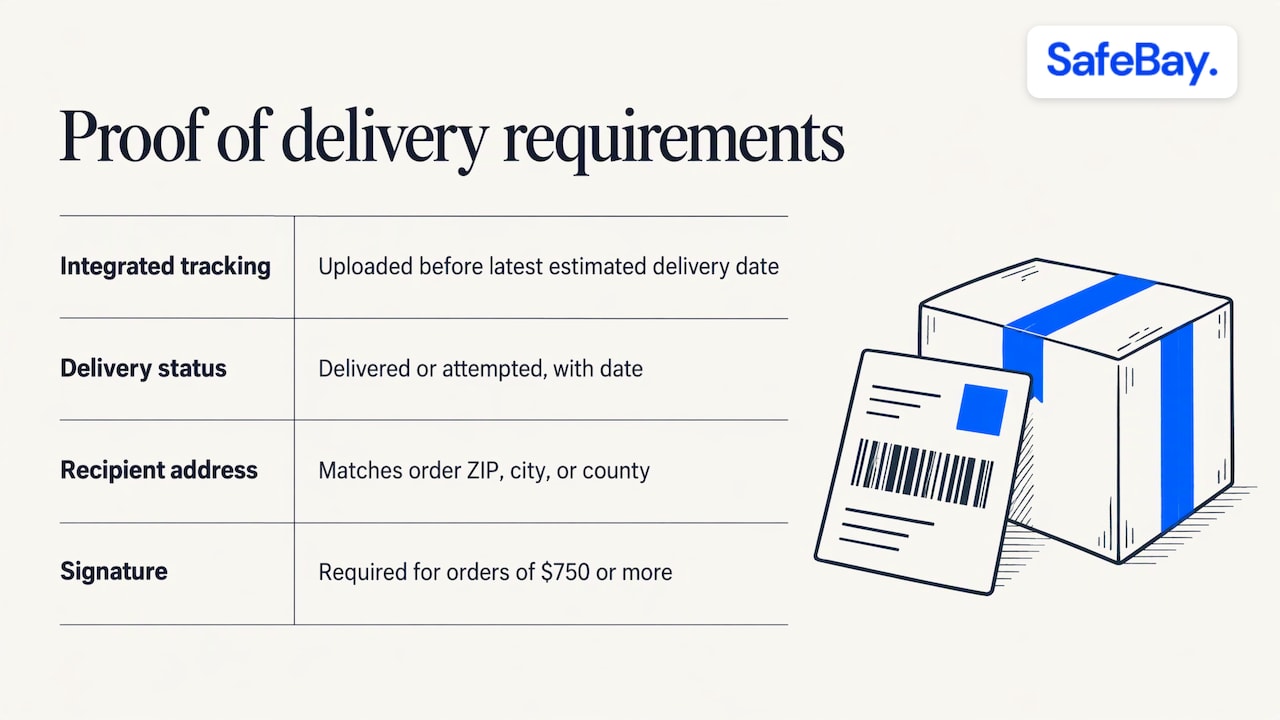
Delivery proof only establishes that a box arrived. To answer an empty-box claim you need proof of what was in it.
The packing record to build before every shipment
CedCommerce's seller guide calls the defense against this claim an ironclad log of the shipping journey: courier details, tracking numbers and the package's weight. Orders & Returns adds original listing photos and pre-shipping photos or videos showing the item's condition and serial numbers. Put together, a workable routine is:
- Save the listing photos and description as they stood when the order was placed.
- Photograph the item, including serial numbers or model plates, just before packing.
- Record a short continuous video of the item going into the box and the box being sealed.
- Weigh the sealed package and record the weight with the tracking number.
- Ship with integrated-carrier tracking and keep the label and receipt.
The weight matters because an item that weighs 3.2 lb leaves a recorded carrier weight that a hollow box cannot match, although OneRep notes that scammers sometimes pad a returned box to the expected weight, so weight is supporting evidence rather than proof on its own.
For higher-value items, documentation habits are the same ones careful buyers and sellers use elsewhere; the paperwork checks described in this guide to buying jewelry online show how much a clear paper trail helps when a dispute begins.
What to do when the claim arrives
Speed and discipline matter more than persuasion. A practical sequence:
1. Respond inside eBay, and only inside eBay
Orders & Returns advises following eBay's return process exactly and keeping all communication in eBay's messaging system, since conversations elsewhere may not count as evidence. Keep your messages factual: the date shipped, the tracking details, and a request that the buyer provide photos of the package as received, including the shipping label and the interior.
2. Check the pattern of the buyer
LifeLock's guide to eBay scams points to warning signs that show up after delivery: a return or refund request filed immediately after shipment confirmation, a returned item that is different from what you sent, or one not in the same condition. A buyer account with no feedback history that does this within hours of delivery is worth documenting. You can look up a buyer's status on SafeBay's buyer check page to see whether other sellers have reported them.
3. Compare what comes back with what you sent
If a return does arrive, record the unboxing on video from the first cut of the tape, with the label visible. Photograph the contents against your pre-shipping photos and serials. eBay's condition of returned items policy allows refund deductions where the item's value has been lost, for example when it was not packed securely enough to survive shipment, and notes that buyers with a history of abusing returns may face consequences. Keep any deduction proportional: eBay's seller protections page says deductions should only recoup the actual lost value, and that sellers can lose protections by unfairly deducting too much. For more on what you may charge, see SafeBay's guide to restocking fees.
4. Report the behavior, clearly
The seller protections page tells sellers to report the buyer and describe the behavior plainly. CoverOn recommends using eBay's Report a Concern page and attaching order confirmations, tracking numbers, photos, unboxing videos and message screenshots. A report that reads "empty box returned, tracking weight 0.4 lb against 3.2 lb shipped, video attached" is easier to evaluate than "buyer is a scammer." The step-by-step version is in SafeBay's guide to reporting a buyer on eBay.
5. Appeal with new evidence if the case goes against you
eBay's appeal guidance lets you contact eBay with new information within 30 days of the case closing, and eBay normally responds within 48 hours. Acceptable evidence includes tracking showing the buyer received the item, proof a return went to the wrong address or was lost in the mail, documents showing the item matches the listing, and proof the buyer was refunded before the case closed. An appeal without new material tends to repeat the first outcome, so gather the packing record before you file.
What eBay's policies cover, and what they leave to you
EBay's abusive buyer policy names misuse of returns as a violation, including returning an item other than the original, using or damaging an item before returning it, and claiming "not as described" when the listing was accurate. It also lists opening a case after already being refunded, opening cases in retaliation after a previous dispute, and filing duplicate or excessive payment disputes. EBay says it evaluates reports on evidence and patterns of behavior.
When eBay finds a violation, the seller protections page says it removes the related negative or neutral feedback and defects, may limit the buyer's ability to request returns, and may suspend the account in serious or repeated cases. If eBay closes a case or appeal because you met your obligations, the same removal applies.
Two practical points follow.
| Situation | What helps most | Where it goes wrong |
|---|---|---|
| Buyer claims the box was empty on arrival | Pre-shipping video, serials, carrier weight | Relying on delivery tracking alone |
| Buyer returns an empty box | Unboxing video of the return, comparison with serials | Opening the box without recording it |
| Buyer repeats across sellers | A documented report with dates and reasons | Reporting without evidence |
| Buyer reappears under a new order | A block that is already in place | Learning about it after the next case |
First, eBay's remedies work on the case in front of it. They remove the damage to your metrics but do not warn the next seller. Second, the protections apply to sellers who use them honestly: eBay says a history of reporting buyers for false "not as described" requests, when the item truly was not described correctly, can cost a seller eligibility. Accurate listings are part of your defense, which is why SafeBay's response guide to item not as described starts with listing accuracy.
Stopping the second empty box
Ebay stopped letting sellers leave negative feedback for buyers in 2008. The practical effect is that a buyer who runs this play on one seller keeps a clean public record, and the next seller meets them without warning. Your own Blocked Buyers list helps only after the buyer has hurt you once.
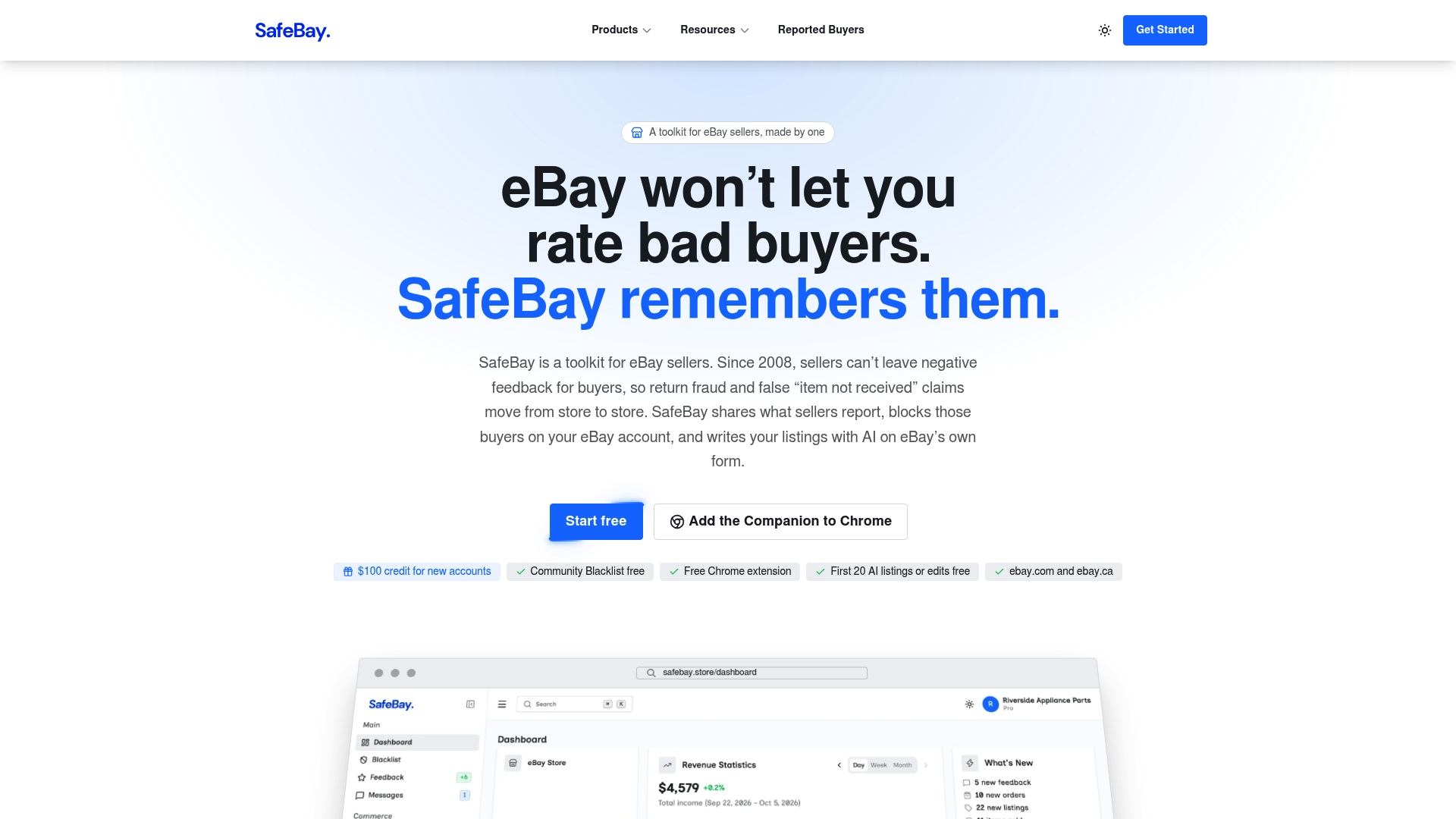
The workable answer is a shared record of behavior, with evidence attached. SafeBay's community blacklist works this way: sellers report adverse buyer behavior with evidence, reports are reviewed, and confirmed ones are shared among the community. The reasons and dates for each listing are kept, blocks can be private or public, and buyers can appeal, so the record stays accountable. SafeBay Companion, the free Chrome extension, syncs these blocks to your eBay Blocked Buyers list and shows real-time risk alerts. You can read how the system fits together on the blacklist page, and see a real swapped-item sequence in the step-by-step return case study.
To file a report yourself, use the report a buyer form with the same material you prepared for eBay: order number, dates, shipping weight, video and the messages. For the wider picture of what each layer covers, see SafeBay's overview of eBay seller protection and its general guide to return fraud.
Where SafeBay fits in your routine
The free plan costs $0 per month and includes basic features with limited AI usage. Paid plans are Basic at $9.95 per month, Pro at $59.95 per month and Enterprise at $599.95 per month, with higher limits and advanced features. Most sellers dealing with return fraud begin with the free Companion extension and the buyer check, then look at the paid tiers when order volume or AI usage grows. SafeBay's return protection page describes the evidence-backed blacklist, and the plans on safebay.store list what each tier adds.
Our view: documentation plus a shared record
Empty-box fraud persists because each seller fights it alone and the evidence disappears when the case closes. A seller documents the package, wins or loses one dispute, and the buyer moves to the next listing with a clean public record.
We built SafeBay around the opposite assumption. A report should carry evidence, a reason and a date, so that other sellers can rely on it and the buyer can contest it. Separating private blocks from public ones and supporting appeals keeps that record fair, and syncing it to eBay's own Blocked Buyers list through a free extension means the protection works at the point where the order arrives, not after the loss.
Treat your packing video and your report as one routine. The video wins the case in front of you, and the report protects the next order.
Mike Brydko
FAQ
Does eBay protect sellers from empty box claims?
EBay's seller protections remove related feedback and defects when it closes a case in your favor, and it can restrict or suspend buyers it finds abusing returns. Success depends on evidence: tracking alone proves delivery of a box, not its contents, so your packing photos, video and weight record carry the case.
What should I do if a buyer returns an empty box?
Record the unboxing on video, compare the contents with your pre-shipping photos and serial numbers, and message the buyer only through eBay. Open or update the case with the video and tracking details, and report the behavior with a clear description. If eBay rules against you, you can appeal within 30 days of closure with new evidence.
Can I leave negative feedback for a buyer who did this?
No. Sellers have not been able to leave negative feedback for buyers since 2008. What you can do is report the buyer to eBay, and report them to the SafeBay community with evidence so other sellers can see the reason and date.
Is every empty package a scam?
No. A damaged carton can let an item fall out in transit, which is why eBay handles empty arrivals as a listing mismatch case and looks at evidence from both sides. Consistent records protect you in either situation, and patterns across several orders are what separate fraud from bad luck.
How do I keep the same buyer from ordering again?
Add them to your eBay Blocked Buyers list. With SafeBay Companion installed, buyers confirmed through the community blacklist are synced to that list automatically, so repeat offenders are blocked before they place another order.
Sources
- eBay Money Back Guarantee policy
- eBay seller protections
- eBay abusive buyer policy
- eBay condition of returned items policy
- eBay appeal guidance for sellers
- Auction Nudge: return fraud on eBay
- CedCommerce: guarding against eBay buyer scams
- LifeLock: common eBay scams
- CoverOn: eBay scams guide
- OneRep: eBay scams guide
- Orders & Returns: eBay return fraud