
For auctions, the best time to list is the one that makes your listing end on a Sunday evening, roughly 7 PM to 9 PM in your buyers' time zone, because most bidding happens in the last hours. For fixed-price listings the start time matters far less than your title, price and photos, so the practical goal is a steady schedule rather than a perfect minute. Below you will find the reasoning, the evidence behind each recommendation, the time zone arithmetic, and a method for checking the result against your own sales.
Why the answer depends on the listing format
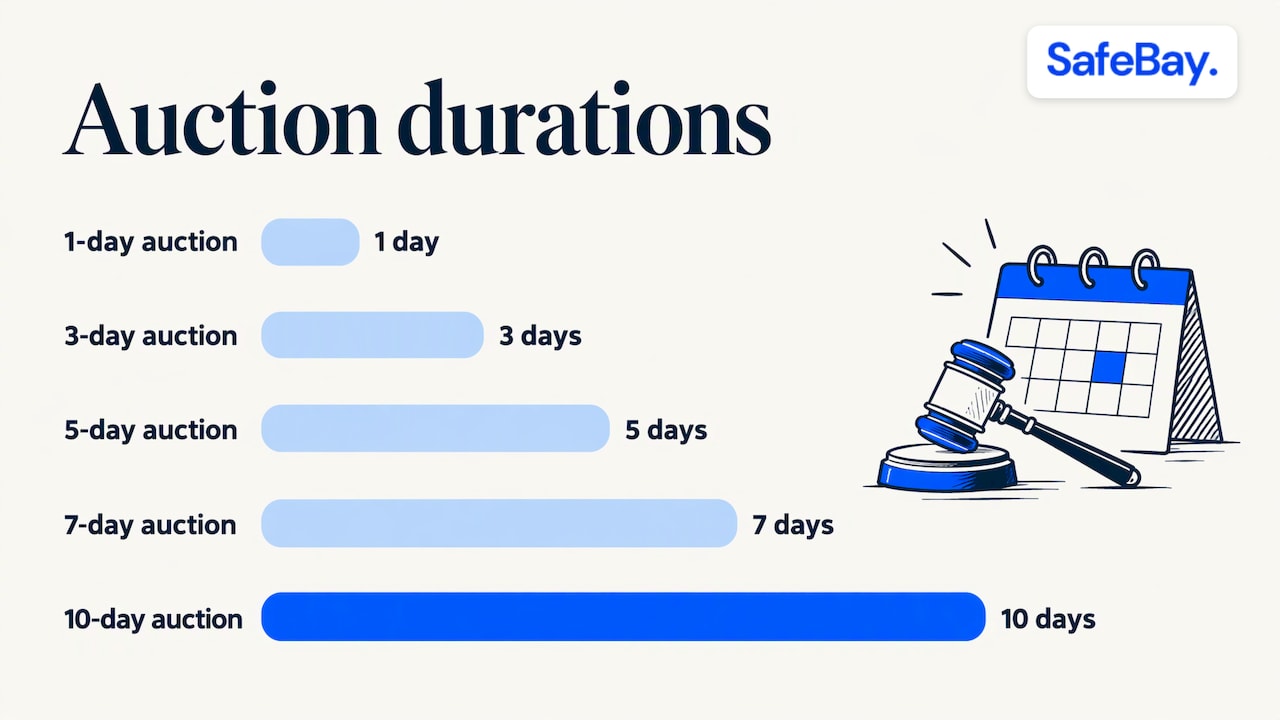
Every recommendation about timing starts from one fact: on eBay, the start time and the end time are linked. According to eBay's help page on listing durations and timings, auction-style listings can run for 1, 3, 5, 7 or 10 days, and a listing ends in whole-day increments from the moment it starts. The page gives the example of a 3-day listing submitted at 1:14 p.m. on Sunday, which ends at exactly 1:14 p.m. on Wednesday. So when people ask when to list, they are usually asking when they want the listing to end, and working backward.
That matters because of how buyers behave. David Karp, in eBay Hacks, explains that most customers see and bid on a listing during its last day, and especially its last few minutes. A seller of an auction is therefore choosing an ending window, and the start time is only the means of getting there.
Fixed-price listings work differently. eBay's help page states that fixed-price listings run as Good 'Til Canceled and renew every month until the item sells or you cancel it. There is no closing moment that concentrates attention, so there is no single hour that does the work an auction ending does. One long-standing seller analysis from The Whine Seller makes the same argument: a fixed-price listing only needs to find one right buyer, while a good auction needs to attract as many bidders as possible at the same time. That is a personal blog from 2008, so treat it as reasoning rather than measurement, but the logic holds for the current format rules.
In practice:
| Listing type | Does timing matter? | What to optimize |
|---|---|---|
| Auction, unique or hard-to-find item | A great deal | End day and end hour |
| Auction, common item | Moderately | End hour, starting price, competition at that hour |
| Fixed price, single item | Slightly | Title, price, photos, steady listing cadence |
| Fixed price, high inventory | Slightly | Consistent daily volume, relisting |
eBay's own seller guidance for optimizing listings says fixed-price suits items of known value or high inventory, while auctions suit unique or hard-to-find items where buyers compete to set the price. Decide the format first, then think about the clock.
Which days are best
Sunday is the most repeated answer, and it has support from several directions. eBay Inc.'s buying and selling tips describe Sunday evening as the busiest time for buyers and suggest scheduling auction endings around then while avoiding weekday mornings and major events. That page is aimed at the U.K. site, and it dates from 2018, so it is best read as a pattern rather than a guarantee for the U.S. market. A 2026 analysis of trading card auctions by Steve Levine reaches the same conclusion for that category: Sunday is the strongest day, and Friday, Saturday and Sunday together account for about 60% of weekly collectible card activity.
If Sunday is the target end day, the start day follows from the duration you pick:
- 7-day auction: start on Sunday evening. The first 24 hours then fall on Monday and the final 24 hours cover Sunday. The Whine Seller makes this point, noting that the last 24 hours bring extra exposure through ending-soon views and impulse bidding.
- 10-day auction: start on Thursday evening, so the listing ends on a Sunday and has run across two weekends.
- 5-day auction: start on Tuesday evening to end on Sunday.
- 3-day auction: start on Thursday evening to end on Sunday.
The duration advice is consistent too. eBay's guidance for optimizing listings recommends 7- or 10-day auctions so more buyers can see the item, paired with a lower starting price and, if you use Buy It Now, a price at least 30% above the starting price.
When everyone ends on Sunday
The obvious objection is crowding. If every seller ends on Sunday evening, your item competes with all of them. Levine raises this directly: for common items listed by dozens of other sellers, a Sunday ending does not help you stand out, while for rare or one-of-a-kind items the larger bidder pool outweighs the extra competition.
Academic work supports the concern with numbers. Uri Simonsohn's study "eBay's Crowded Evenings" found that bidders place 25.0% of their bids between 5:00 and 8:59 p.m., yet 37.6% of auctions end in those hours. For a single-DVD auction, the study estimated that ending around noon instead of 8 PM raised the odds of selling by 13 percentage points and the expected price by about 4%. The data comes from the early 2000s and a single product type, so it does not overturn the Sunday-evening rule, but it explains why a common item can do better with a less congested ending slot.
A workable rule follows from both sources:
- Rare, collectible or hard-to-find item: end on Sunday evening and let the larger audience work for you.
- Common item with many identical listings: consider a weekday evening or a midday ending, and compare results against Sunday.
- Anything you are unsure about: run both and measure, using the method later in this article.
Best hours and time zones
The consistent window across the sources is the evening. DHL eCommerce's selling tips cite Sunday between 7 PM and 9 PM as the best time to end an auction, and Levine's card analysis gives 7:00 to 11:00 p.m. Eastern. A UNC Information Science study of eBay traffic measured hits every 15 minutes across a week and found that the final hours of an auction draw the most traffic, with Monday mornings between 9 AM and 2 PM also busy.
The complication in the United States is geography. eBay's help page notes that listing times on eBay.com display in Pacific time, so the time you see in the listing tool is not necessarily your buyer's time. eBay Motors recommends an early-evening Pacific end time to cover all four U.S. time zones during peak evening hours. The arithmetic from that page:
| Ending time (Pacific) | Mountain | Central | Eastern |
|---|---|---|---|
| 6 PM | 7 PM | 8 PM | 9 PM |
That is why a 6 PM Pacific ending is a common default: buyers on the East Coast are at 9 PM, and buyers on the West Coast have just finished the workday. If your item sells mainly to one region, shift accordingly. A Midwestern-heavy category might favor 5 PM Pacific, which is 7 PM Central.
For a listing that ends at 6 PM Pacific on a 7-day auction, you would submit it at 6 PM Pacific seven days earlier. eBay lets you schedule a start day and time up to three weeks in advance, so you can set this up during a quiet part of your week instead of being at the keyboard at the exact minute. For the mechanics, see our guide to scheduling listings on eBay.
Timing fixed-price listings
For fixed-price inventory, the question changes from "when does it end?" to "how do I keep fresh listings appearing?" DHL eCommerce's tips recommend listing one item a day rather than uploading everything at once, which spreads your new-listing exposure across the week. If you have 30 items, you get 30 days of fresh-listing visibility instead of one.
Several practical habits follow:
- Stagger the batch. Use scheduled start times to release a few items per day, ideally in the evening hours when buyers browse.
- Keep the listing live. Because Good 'Til Canceled listings renew monthly, an unsold item does not need a rebuild, but it does benefit from being refreshed. Our article on auto-relisting versus promoted listings covers how relisting affects visibility.
- Fix the content before the clock. Search placement depends on titles and item specifics, which is covered in our piece on eBay SEO and Cassini's ranking signals. A perfectly timed listing with a weak title still gets little traffic.
- Check the price. Timing cannot rescue an item priced above the market. See eBay pricing strategy for how to set it.
Seasons, categories and holidays
The month matters as much as the hour for seasonal goods. eBay's Fashion Selling Guide notes that men's swimwear sells best in July, women's swimwear peaks in June, back-to-school items are popular in August, Halloween costumes spike in October, and holiday gifts drive November and December. The practical reading is that you should list seasonal inventory ahead of the peak, so the listing has time to collect views and a sales history by the time demand arrives.
Category patterns can also shift the best day. A 2026 reselling guide from Hero Stuff suggests Sunday evening from 7 PM to 9 PM local time as a general default, then offers variations: furniture and large items on Saturday mornings, electronics from Sunday night through Monday morning, and kids' gear on Monday and Tuesday evenings. Treat those as hypotheses to test, since they come from one reseller guide rather than eBay data.
Two cautions about holidays. The Sunday-evening rule weakens on major holiday weekends, when buyers are traveling or away from screens, and eBay Inc.'s tips advise avoiding big events for auction endings. Check your calendar before setting an end date that lands on one.
Our perspective on timing
Timing advice for eBay is easy to find and hard to trust, because most of it is a single seller's experience repeated until it sounds like a rule. The better approach is to treat the Sunday-evening window as a starting hypothesis and then use your own numbers to confirm or replace it.
We built SafeBay for sellers who run eBay as a business, and the pattern we care about is consistency. A seller who relists ended items, keeps listings fresh and reviews sales by day and week learns more from a month of data than from any article, including this one. SafeBay includes auto-relisting of ended items and sales analytics for exactly that reason: so that the schedule you choose is carried out without manual effort, and so that the results are visible by day, week and month.
Our advice is to pick one schedule, hold it long enough to see a pattern, and change only one variable at a time.
Mike Brydko
How to test your own listing schedule
Published timing studies describe averages across many sellers and categories. Your buyers may behave differently, so a short test is worth running. The following process works with the data eBay already gives you.
- Choose one category of items. Pick products that are similar in price and demand, such as one type of part or one line of apparel. Mixing categories hides the timing effect.
- Set a baseline. Record views, sales and sell-through for the past four to eight weeks. eBay's Seller Hub performance reports, described in its guide to monitoring your business in Seller Hub, include traffic figures such as impressions, click-through rate and sales conversion rate.
- Change one variable. Move your auction endings from a weekday to Sunday evening, or shift your fixed-price releases from morning to 7 PM, but never both together.
- Schedule it in advance. Use eBay's scheduling option, which lets you pick a start date and time up to three weeks ahead, so the test runs on the exact times you intended.
- Run it for several weeks. One weekend of results is noise. Look at a full month where you can, which matches the advice from long-time sellers to judge sales over longer periods rather than single days.
- Compare the same metrics. Look at views, sell-through, final price and the number of bids for auctions, not only whether the item sold.
- Keep what works, then test the next variable. Move to the time zone, the duration or the day.
The weak point in this process is usually the manual work: remembering to relist, keeping the cadence, and reading results from several screens. That is where SafeBay's orders dashboard and sales statistics help, since revenue is broken out by day, week and month, and the auto-relist tool handles ended items so your schedule does not depend on you being at your desk. Our guide to optimizing eBay listings covers the visibility gaps worth checking alongside timing.
Put your schedule on autopilot with SafeBay
SafeBay is a toolkit for eBay sellers that includes auto-relisting of ended items, AI-powered listing generation and proofreading directly on eBay, and sales analytics. The Free plan costs $0 per month and covers basic features with limited AI usage. The Basic plan is $9.95 per month, and the Pro plan is $59.95 per month, with higher limits and advanced features. You can see the current plans on the SafeBay home page.
If you are building listings in volume, the AI listing generator drafts titles, item specifics and a price, so the listings you schedule are ready to go live in the evening window you chose.
FAQ
What is the best day to list an auction on eBay?
There is no single start day, because the end day is what counts. Aim for the auction to end on a Sunday evening, which means starting a 7-day auction on Sunday or a 10-day auction on Thursday. If your item is common and many sellers end on Sunday, test a weekday evening against it.
What time of day should I list on eBay?
For auctions, choose a start time that makes the ending land between 7 PM and 9 PM in your buyers' time zone. An ending of 6 PM Pacific covers 9 PM Eastern, 8 PM Central and 7 PM Mountain. Remember that eBay.com shows listing times in Pacific time.
Does timing matter for fixed-price listings?
Less than for auctions. Fixed-price listings have no closing rush, so a regular cadence, such as one item a day, and strong titles and pricing matter more. You can still schedule the start time for the evening, when many buyers browse.
How far ahead can I schedule an eBay listing?
eBay lets you schedule a listing to start on a chosen day and time up to three weeks in advance. You can reschedule or cancel a scheduled listing from your scheduled items in My eBay. Our guide to scheduling listings on eBay walks through the steps.
Is the best time to list the same all year?
No. Seasonal goods peak in specific months, such as swimwear in June and July and holiday gifts in November and December, so list them ahead of demand. The weekly pattern of Sunday-evening endings holds more steadily, though major holiday weekends can disrupt it.
Sources
- Listing durations and timings, eBay
- Buying and Selling Tips, eBay Inc.
- 8 Tips To Help You Sell More On eBay, DHL eCommerce UK
- When is the best time to list my item on eBay?, The Whine Seller
- The Best Time of Day to End a Pokémon Card eBay Auction
- How to optimize your listings, eBay Export
- eBay's Crowded Evenings, Uri Simonsohn
- Internet Auctions: eBay Electronic Commerce, UNC
- Schedule Your Listing for Optimal Exposure, eBay Hacks
- eBay Motors time zone guidance
- eBay Fashion Selling Guide
- Best Days and Times to Post Listings, Hero Stuff
- How to monitor your business in Seller Hub, eBay Export