Appliance parts compatibility comes down to one rule: start with the full model number from the appliance's identification tag, resolve the component in model-specific parts information, and order only by the part number that results. Brand, symptom and appearance are not reliable substitutes. This guide explains how to read the identifiers, check a cross-reference, deal with discontinued parts and describe fitment in an eBay listing so that buyers order the right item the first time.
Why the full model number matters
The Appliance411 parts guide treats the model number as the key reference. You read it from the appliance's identification tag, then move through the chain "model number > part number > part." The serial number usually tells you the age of the unit and has limited value for parts, with some exceptions.
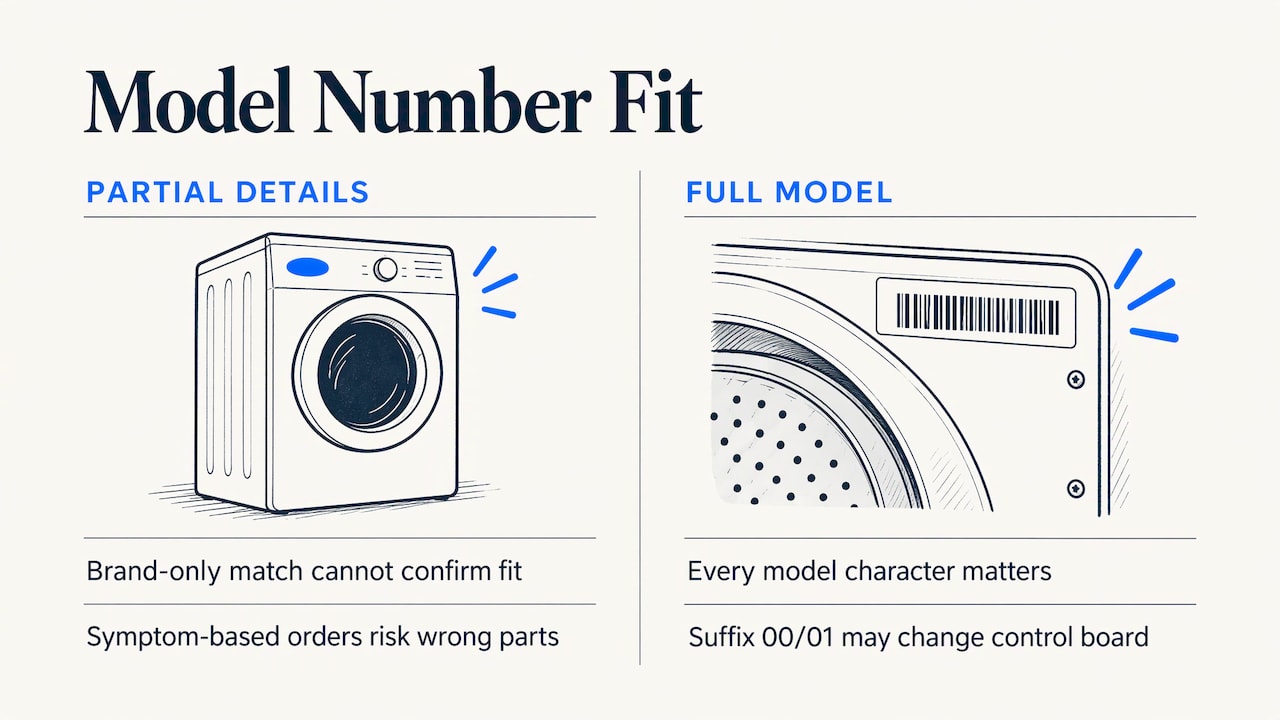
The reason for insisting on every character is that model numbers are structured. ServiceMag's guide to reading model and serial numbers explains that ordering by symptom or brand alone leads to wrong parts and wasted time, and that a single suffix letter or number can mean a completely different control board, motor or wiring harness. A control board for a unit ending in 00 may not fit one ending in 01, even if the two boards look identical.
For a seller, this has a practical consequence. A buyer who writes "fits my Whirlpool dryer" has not given you enough to confirm anything. A buyer who sends the full model number from the tag has.
Where to find the tag
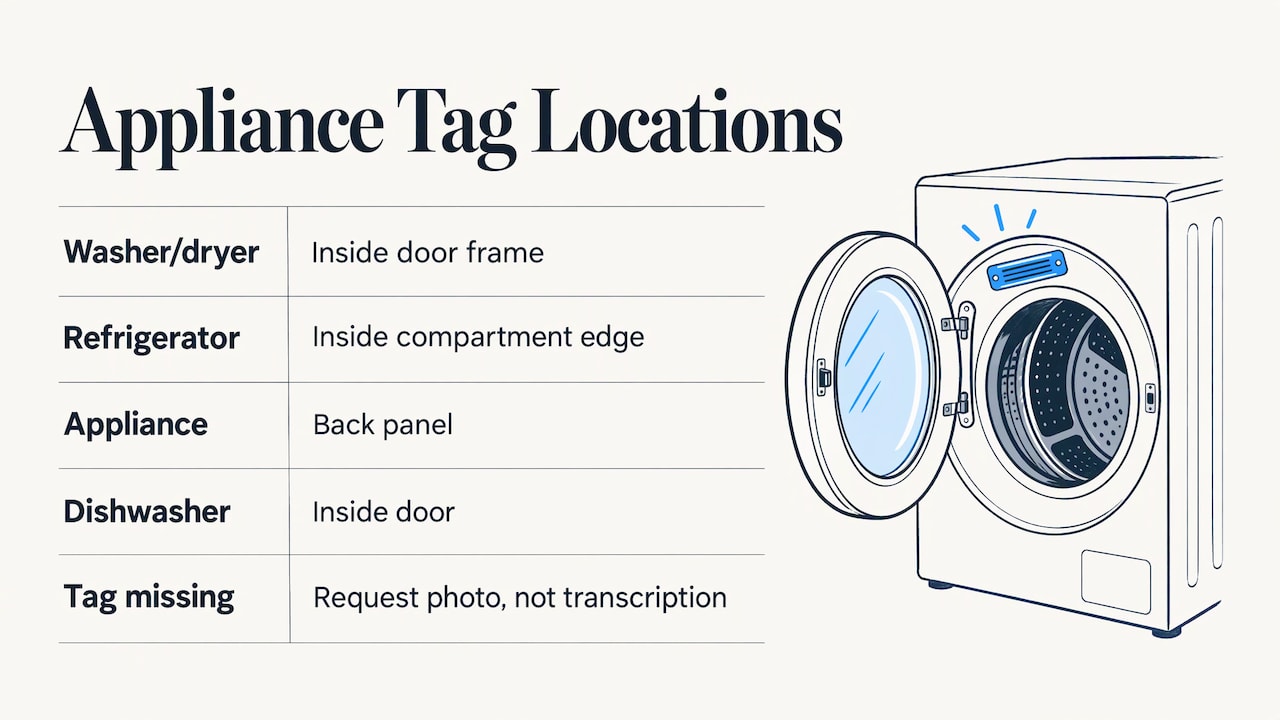
The location varies by product type and brand, so there is no single rule. Common places include inside the door frame of a washer or dryer, along the inside edge of a refrigerator compartment, on the back panel and inside a dishwasher door. When a customer cannot find it, ask for a photo of the tag rather than a typed transcription, because characters such as 0 and O or 1 and I are easy to confuse by hand.
What the serial number can add
Serial numbers often encode a production date, and that date can matter. According to ServiceMag, Whirlpool serials are 9 or 10 characters long, with a date code that uses one letter for the year and two digits for the week, 01 to 52. The year letter repeats on a cycle of roughly ten years, so one letter can map to more than one year and the decade has to be confirmed from the condition of the appliance or the purchase records.
Since this comes from a content guide and not from the manufacturer, treat the decoding as a starting point and confirm it with the brand's own parts system when a sale depends on it.
From model number to part number
Once you have the full model number, the dependable method is the same across brands:
- Locate the appliance model in the manufacturer's parts system or in an authorized parts catalog.
- Open the assembly diagram for the section that contains the failed component, such as the door, the control panel or the pump.
- Identify the component on the diagram and read its part number from the parts list.
- Order or list by that part number, and note the model it was verified against.
GE's official guidance follows this logic. GE's discontinued-parts page says that when the required part number is unknown, you should find the appliance model in GE's Parts and Accessories system and use the relevant assembly diagram to identify the replacement.
Diagrams also answer a question that listings often leave open: whether the replacement is a single piece or a kit. Pantheon's discontinued-part guide notes that model diagrams can clarify what a kit includes and what is sold separately.
Numbers that look like part numbers but are not
Appliance411 warns that a number stamped on a part may be a manufacturing code and not an orderable part number, and that an isolated four-digit code may be a date code. Before you copy a number from a worn component into a search box or a listing, check it against the diagram or parts list for the model.
What changes compatibility inside one model
Two appliances can share a model number and still use different parts. The reasons sellers meet most often are:
| Variable | What it can change | How to check |
|---|---|---|
| Suffix or revision in the model number | Control board, motor, door gasket, wiring harness | Compare the full model number, including the suffix, against the parts list |
| Production date in the serial number | Internal component version used at assembly | Decode the serial with the brand's guidance and confirm with the parts system |
| Serial range restrictions | Whether a part applies to early or late units | Look for range notes in the diagram or supersession information |
| Color set or trim level | Panels, handles, some trim parts | Match the exact model, not only the product line |
| Supersession | The original part number replaced by a newer one | Check whether the number has been superseded before listing |
The ServiceMag guide gives the suffix example above. A KitchenAid lookup guide on HomeAppliances.blog goes further and says components can change during a production run, so a unit built in week 25 might use different parts than one built in week 40 of the same year. These are secondary sources, so use them as a reason to check the serial range, not as a figure to quote to a customer.
How to verify a cross-reference
A cross-reference table pairs a part number from one source with an equivalent from another, and sellers often use one to answer "will this fit?" quickly. It is useful for narrowing the field. It is not confirmation by itself.
A sensible verification routine has four checks:
- Confirm the model. The cross-reference should be tied to the full model number, not to a product family.
- Confirm the number type. Make sure the number you were given is an orderable part number and not a date or manufacturing code.
- Check for supersession and serial-range limits. Pantheon's guidance recommends confirming the exact model, serial or production code, identifying the component in the model-specific diagram and checking supersession and serial-range restrictions, and only then evaluating documented cross-compatibility.
- Compare physical and electrical details. Pantheon cautions that visual similarity does not prove interchangeability. Connectors, electrical ratings, bracket geometry and gasket profiles can differ even when two parts look the same.
When sources disagree, or only one source supports a match, treat that as a reason to keep investigating. A single-source match is not proof.
Safety-critical parts need a stricter standard
For parts that handle heat, water sealing, gas or electricity, such as heating elements, thermostats, gas valves, door interlocks and control boards, the same guidance points to stricter confirmation of ratings, connectors, certifications and application documentation, rather than relying on a generic cross-reference. If a buyer is unsure, the right advice is to have a qualified appliance technician confirm the part before installation, particularly for gas appliances.
Finding a replacement when the part is discontinued
Discontinued does not always mean unobtainable, but the options narrow. GE states that when a service part is no longer available, it cannot substitute a compatible part. Its guidance is to search by the exact part number through authorized distributors or through used or refurbished sources.
That gives a workable order of operations:
- Confirm the exact part number from the model-specific diagram.
- Check whether the part number has been superseded by a new one.
- Search that exact number across authorized distributors and used or refurbished inventory.
- Only if no match exists, evaluate a documented cross-compatible part, applying the verification checks above.
- If the part is also safety-relevant and no documented match exists, recommend repair or replacement decisions to a qualified technician.
For eBay sellers, used and refurbished sourcing is where much of this demand lands. A listing that carries the exact part number and the verified model numbers is the one a buyer searching for a discontinued part will find and trust.
Writing compatibility into your eBay listing
Most disputes in parts sales start with a listing that left fitment to the buyer's guess. A listing that prevents them includes:
- The exact part number, and any superseded or alternate numbers you have confirmed.
- A list of full model numbers the part has been verified against, written in the same format as the tag.
- Any limits, such as serial ranges, revision suffixes or color sets the part does not apply to.
- Whether the item is new, used or refurbished, and whether it is OEM or aftermarket.
- What is included, especially when a part is sold with or without hardware, a harness or a gasket.
- A direct instruction to compare the model number on the buyer's tag with the list before buying.
These details also support search. eBay's own fields for brand, model and part number depend on accurate entries, and our guide to eBay item specifics and required fields covers how to fill them. Once the listing is accurate, pricing strategy for profit on eBay is the next question, and it is easier to answer when you know what comparable parts have actually sold for.
Answering a buyer who is not sure
A buyer message usually reads "will this fit my washer?" with no model number. A repeatable reply keeps both sides protected:
- Ask for a photo of the identification tag, not a typed number.
- Compare the full model number against your verified list.
- If it matches, say so and state which model it was checked against.
- If it does not match or you cannot confirm it, say that you cannot confirm fit and suggest the buyer verify the part number against the manufacturer's parts diagram for their model.
An answer that says "I cannot confirm this fits" is better than a guess, because it avoids a return request that begins with "item not as described."
Our perspective
We built SafeBay for eBay sellers, and appliance parts show why seller-side tooling matters. The product is small, the model numbers are long, and a single wrong character produces a return. Most of the cost lands on the seller, who pays for shipping both ways and cannot leave negative feedback for a buyer who ordered carelessly or made a false claim.
That is why we treat compatibility and buyer risk as one workflow. Our Appliance Parts Locator is designed to let sellers look up parts by model number and see eBay sold prices alongside, so the identification step and the pricing step happen in the same place. A seller who lists with a verified part number and clear fitment limits has fewer mismatched orders to begin with.
For the orders that still go wrong through bad faith, our community blacklist lets sellers report a buyer with evidence, and our free Chrome extension is designed to sync reviewed blocks to the eBay Blocked Buyers list. We keep the reasons and dates for each entry, separate private blocks from public ones and support appeals, because a blocklist is only useful when it is accountable.
Our advice is consistent: verify the full model number, list what you verified, and use the tools that remove the repetitive work.
Mykola
Using SafeBay in a parts-selling workflow
SafeBay offers eBay sellers a free plan at $0 per month with basic features and limited AI usage. Paid plans are Basic at $9.95 per month, Pro at $59.95 per month and Enterprise at $599.95 per month, with higher limits and advanced features. Parts compatibility lookup, AI-assisted listing generation and proofreading, auto-relisting, buyer risk alerts and order management tools are part of the toolkit, and plan details are on the SafeBay plans page.
Sellers who want to start with the lookup can open the Appliance Parts Locator. Those who want buyer protection can install the SafeBay Companion extension or check a specific account on the buyer status page.
A repeatable checklist before you list or ship
- Photograph the tag and record the full model and serial number.
- Resolve the component in the model-specific diagram and note the part number.
- Check supersession and serial-range notes.
- Confirm that the number is an orderable part number and not a date code.
- For heat, water, gas or electrical parts, compare ratings, connectors and certifications.
- List the verified model numbers and any limits in the listing.
- Keep the buyer's tag photo and your compatibility notes with the order record.
The last step matters when a dispute arises. A record showing what the buyer asked, what you verified and what the listing stated is the clearest evidence of a good-faith sale.
FAQ
What is the most reliable way to check appliance parts compatibility?
Use the full model number from the appliance's tag, find the component in the model-specific parts diagram and order by the part number shown. Appliance411 describes this as the chain from model number to part number to part. Matching by brand, symptom or appearance is where wrong orders usually start.
Can I trust a cross-reference for appliance parts?
Treat it as a lead. A cross-reference is often a drop-in fit, but part numbers can vary by model and serial range, so confirm it against the exact model. For heating, water, gas or electrical parts, also compare ratings, connectors and certifications.
Does the serial number matter for parts?
Sometimes. It usually identifies age and has limited parts value, but components can change during a production run, so the production date can decide which version fits. Check the manufacturer's parts information when the model has more than one version.
What if the manufacturer no longer sells the part?
GE says it cannot substitute a compatible part when a service part is discontinued, and it points users to the exact part number through authorized distributors or used and refurbished sources. Check for supersession first, then search by exact number. A qualified technician should approve any substitute for a safety-related part.